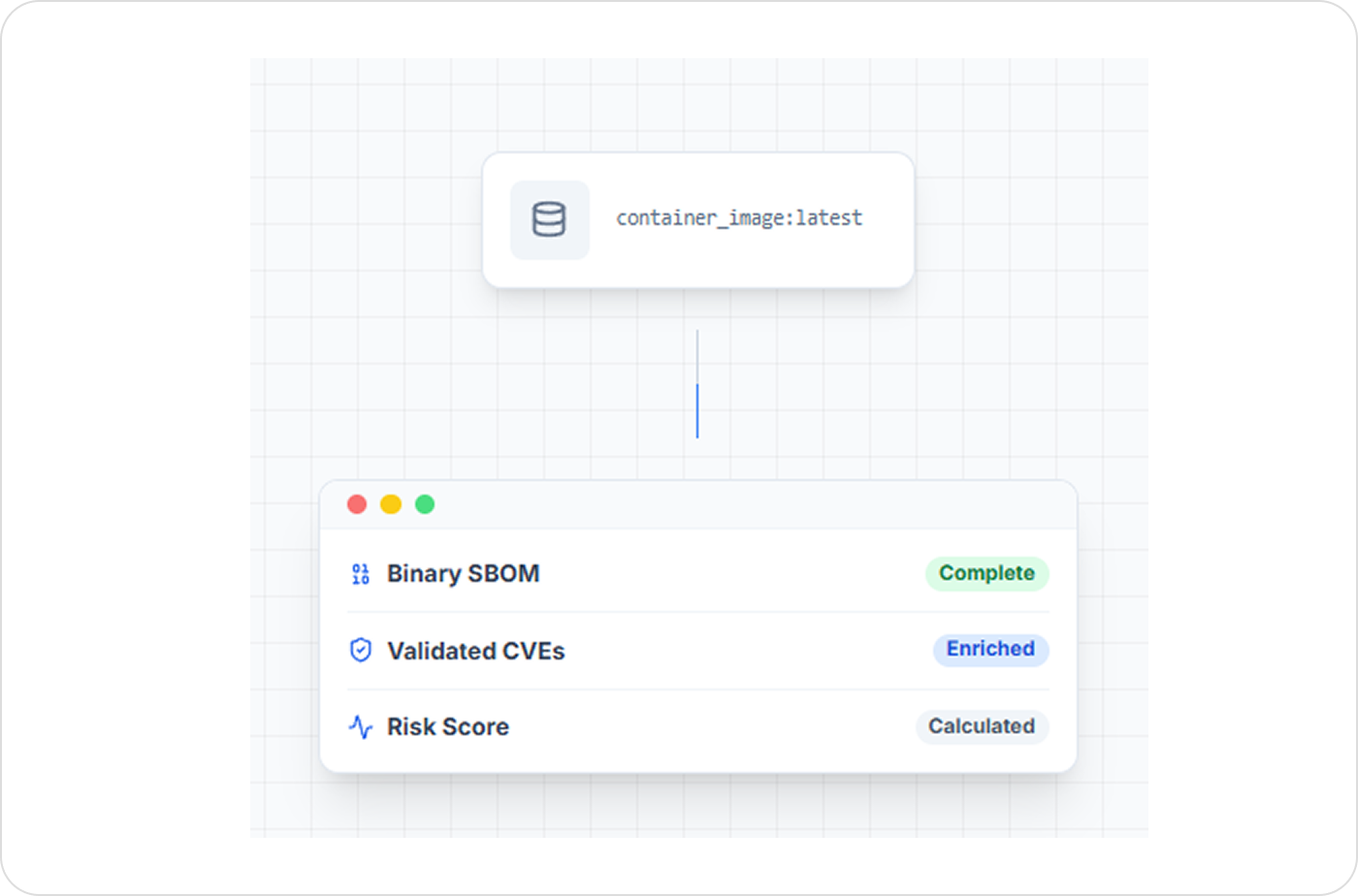
RF Profiler converts real workload behavior into runtime evidence that teams can use immediately.
A continuously updated record of components actually executed in production.
Distinguishes active code paths from dormant layers to reduce noise in vulnerability triage.
Establishes expected runtime behavior and flags deviations that require attention.
Designed for continuous profiling while keeping overhead under 1%.
Identify CVEs in executed components to focus on real, reachable security risks.


Detect unauthorized binaries, configuration changes, or unexpected behavior across clusters.
Provide execution truth needed to safely remove unused components without service disruption.

Achieved by eliminating vulnerabilities in non-executed components.
Driven by safe removal of unused binaries and libraries.

RBOM data shows exactly where vulnerable code is running.
Continuous profiling with under 1% overhead and no workload disruption.
RF Profiler provides security and platform teams with the runtime clarity needed to reduce risk and harden containers with confidence.
Step 1
Install via Helm with no agents, restarts, or pod mutations.
Step 2
Profiler monitors active binaries, libraries, and execution paths across running workloads.
Step 3
Outputs a runtime-validated inventory that filters out non-executed, non-exploitable components.
Step 4
RBOM™ data guides automated removal of unused components through RF Optimizer.
Identify CVEs in executed components to focus on real, reachable security risks.
Detect unauthorized binaries, configuration changes, or unexpected behavior across clusters.
Provide execution truth needed to safely remove unused components without service disruption.
After hardening with execution-aware data
during cluster-wide runtime profiling
versus static-only scanning
to enable runtime insight