The Security Realities Driving AI Infrastructure Risk
AI stacks inherit thousands of vulnerabilities from OSS dependencies
AI platforms rely heavily on open-source components (Python libraries, ML frameworks, vector DBs, APIs, backend services) that often contain large CVE backlogs before verification.
Rapid release cycles outpace traditional vulnerability management
Frequent builds, rapid iteration, and constant deployment mean vulnerabilities propagate into production faster than security teams can manually patch.
Limited visibility into what is actually running
AI systems span microservices, APIs, model gateways, schedulers, and backend components — making it difficult to see active vulnerabilities or prove security lineage.
How RapidFort Reduces AI Software Risk
Start Secure with Curated Near-Zero CVE Foundations


Prioritize True Risk with Analyzer & Profiler Intelligence
Continuously Reduce Exposure with Optimizer & CART

Outcomes AI Teams Can Count On
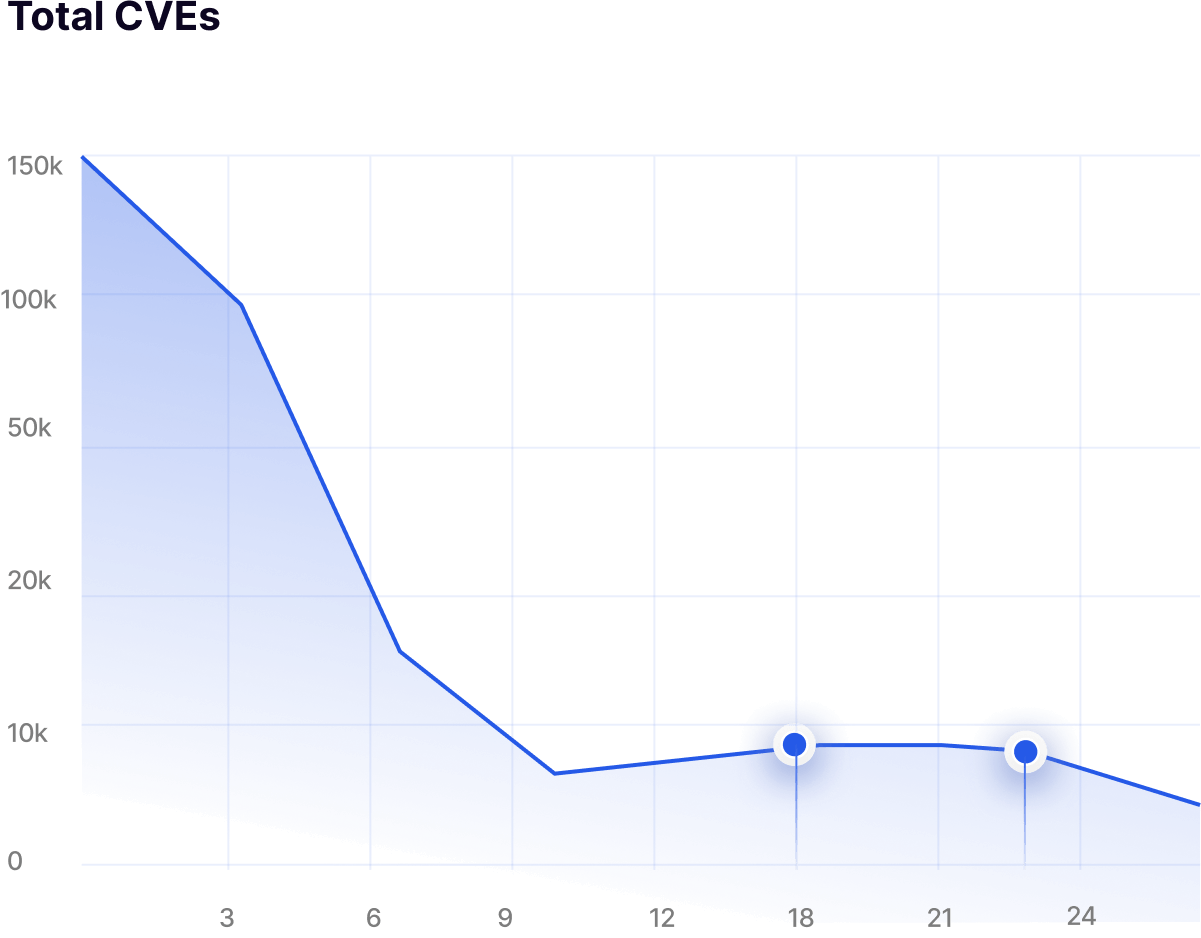
↓ up to 95% CVE reduction
Across containerized AI services and platform components
↓ up to 90% attack-surface
Attack-surface reduction through automated hardening

Weeks → Days
Audit readiness accelerated from weeks to days
↓ ~60% Less manual work
reduction in manual vulnerability remediation effort
Compliance-Ready Evidence for AI Platforms
SOC 2 (Type II)
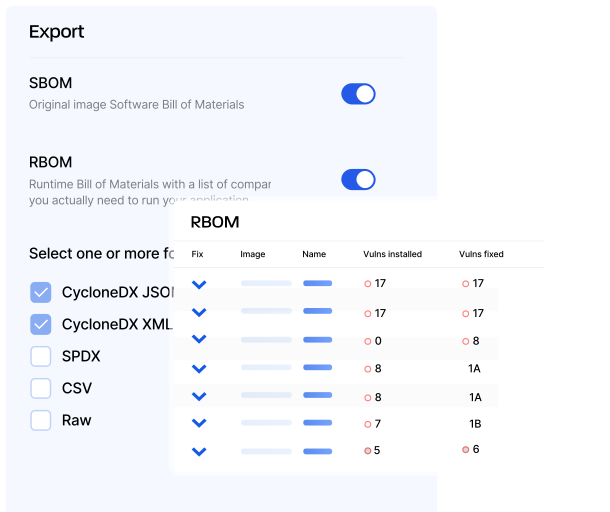
Continuous vulnerability validation, hardened baselines, and SBOM/RBOM evidence for AI platform releases.
ISO/IEC 27001
CIS/STIG-aligned configurations and exportable evidence mapped to Annex A controls for information security and operational resilience.
FedRAMP-Aligned Cloud Environments
Deploy FIPS-validated, STIG/CIS-hardened containers with reporting that supports FedRAMP and cATO workflows for AI cloud services.
AI Trust, Transparency & Security Reviews
Deliver component lineage and runtime-verified RBOM™ to support AI security assessments, customer reviews, and platform assurance programs.
See what our users think about RapidFort
Frequently asked questions
Answers to Your Most Common Questions
RapidFort is a Software Supply Chain Security platform that helps teams identify, prioritize, and remediate software vulnerabilities—without code changes—by combining DevTime Protection Tools, Curated Near‑Zero CVE Images, and RunTime Protection Tools into a Software Attack Surface Management (SASM) workflow. Typical outcomes include up to 95% CVE remediation and up to 90% attack surface reduction driven by runtime intelligence.
Step 1 — Inventory & Understand (DevTime Protection Tools):
Integrate with your CI/CD pipeline or directly into your Kubernetes environment to scan container images, generate SBOM/RBOM™, reconcile scanner findings, detect drift, and profile execution paths using binary scanning. Outputs include SPDX/CycloneDX reports and RapidRisk Score to prioritize real risk.
Step 2 — Remediate & Automate (Curated Near‑Zero CVE Images):
Drop‑in 10,000+ curated images built on LTS distributions (Alpine, Debian, Red Hat, Ubuntu), hardened with STIG/CIS in alignment with NIST SP 800‑70, with FIPS 140‑3 validation and continuous patching—so teams start with near zero CVEs. No vendor lock‑in.
Step 3 — Maintain & Defend (RunTime Protection Tools):
Enforces runtime‑guided hardening to remove unused components, continuously monitors baselines, and alerts on anomalies—achieving up to 95% CVE remediation and up to 90% attack surface reduction with <1% compute overhead.
They are production‑grade base images that are continuously patched and scanned, available across LTS Linux (Alpine, Debian, Red Hat, Ubuntu), hardened using STIG/CIS benchmarks (aligned to NIST SP 800‑70), and offered at scale (10,000+ images). They are designed to accelerate FedRAMP/CMMC/SOC 2 readiness and avoid lock‑in by using widely adopted distributions.
Secure Your AI Software Supply Chain Today
Protect your AI platform, microservices, and supporting infrastructure with continuous vulnerability visibility, automated hardening, and compliance-ready evidence.