
01
The open source ecosystem has long thrived on transparency, community oversight, and freedom of choice. The results have been transformative. However, a new category of Linux distributions is emerging that puts these principles at risk.
Proprietary open source distributions present themselves as security-focused solutions, but beneath the surface lies a shift toward vendor lock-in, opacity, and potential exploitation.
Traditional enterprise Linux distributions such as Ubuntu and Red Hat's Universal Base Image (UBI) benefit from something invaluable: the scrutiny of millions of developers worldwide. When vulnerabilities are discovered, when packages break, or when decisions go wrong, the community responds quickly with feedback, patches, and alternatives. This is a proven model, and a vast share of the world's software systems run on and benefit from this approach.
Proprietary distributions operate under a fundamentally different model. Without the breadth of community oversight that established distributions enjoy, there are no natural checks and balances. The vendor becomes both the gatekeeper and the judge of what constitutes a vulnerability, and what counts as secure, stable, or high quality. This concentration of control removes the community feedback loop that has made open source software trustworthy for decades.
Developers providing community oversight in established distros
Of proven open source security through community scrutiny
Vendor controls both patches and vulnerability narrative in proprietary models
02
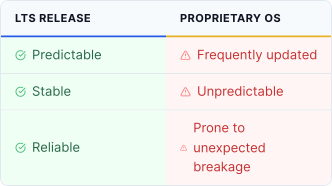
Long-Term Support (LTS) releases exist for a reason. Enterprise applications require stable, predictable platforms that will not introduce breaking changes unexpectedly. Ubuntu's five-year LTS cycles and Red Hat's decade-long support windows provide the foundation that critical applications depend on.
Proprietary OS distributions often promote an "always up to date" approach, with daily or continuous updates to the base operating system. While this sounds appealing from a security standpoint, it introduces meaningful risk for production environments. An application that worked yesterday may break today because a core library was updated.
Multiplied across every update cycle, this creates an environment of ongoing unpredictability, where every upgrade carries real risk of unexpected failure.
Security scanners and vulnerability management tools rely on clear, transparent information about how operating systems and packages are patched. Established distributions publish detailed security advisories tied to public CVE databases, which allows independent verification and assessment.
Proprietary distributions often maintain their own advisory systems: closed ecosystems where the vendor controls not only the patches but also the narrative around vulnerabilities. This creates a real risk that CVEs are downplayed or obscured behind proprietary classification schemes that make the true risk landscape harder to see.
When a vendor controls both the problem and its disclosure, the potential for a conflict of interest is significant. Organizations may believe they are secure based on a vendor's assurances, while real vulnerabilities remain invisible to third-party security tools.
Fewer independent eyes reporting on vulnerabilities can create the appearance of fewer vulnerabilities, but this is an illusion rather than a genuine security improvement.
03
This is where the business model of proprietary distributions reveals its true nature. These distributions position themselves as "open source" to gain credibility and initial adoption, but the reality is different in practice.Once an application has migrated to run on a proprietary distribution, the organization is no longer participating in open source; it is dependent on a single source. The software is no longer fully under the organization's control, and any patch or update requires returning to that vendor.

Single-source dependency creates significant leverage for future price increases. The broader software industry has seen this pattern before: once customers are sufficiently locked in, pricing can rise substantially.
For organizations running FedRAMP-certified applications or complex on-premises solutions, removing a base operating system is not a simple project. It is a months-long engineering effort requiring recertification, testing, and redeployment, and switching costs of that size give the vendor considerable pricing leverage.
There is a related risk that is easy to underestimate: the more components an organization relies on from a single vendor, including not just container images but the packages themselves, the more dependent that organization becomes. In effect, the organization's software becomes reliant on the vendor's roadmap and decisions. During any migration window, the organization is exposed to whatever pricing or terms the vendor chooses to set, which creates significant financial and operational risk.
04
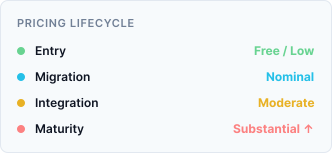
The initial pitch from proprietary distribution vendors is typically attractive: low costs, and sometimes free tiers for developers to try the platform and evaluate its security approach. Developers, often looking for better tooling, may adopt these platforms without fully weighing the long-term tradeoffs.
Once migration is complete, sometimes with the vendor's own professional services assisting that migration, and once containers, CI/CD pipelines, and security compliance processes depend on that vendor's base images, repositories, and advisories, pricing terms can change. Subscription costs may increase, and features may move to higher tiers. In this pattern, the initial low pricing functions primarily as a customer acquisition strategy rather than a lasting value proposition.
Red Hat UBI and Ubuntu maintain extensive package repositories built over decades, supporting a wide range of applications and use cases, largely free to use. Proprietary distributions, by their nature, cannot match this breadth. A single company, however well resourced, cannot out-produce an entire open source community.
This has two consequences on ecosystem fragmentation:
many packages available in established distributions may not exist in proprietary alternatives, which can make certain applications difficult or impossible to deploy without significant rework, since there is no guarantee of one-for-one package equivalence.
every package an organization does use must come from that same proprietary vendor, further deepening dependence on it.
These gaps often surface application compatibility issues that are not apparent until an organization is deep into a migration. A partial migration is generally not sufficient to ensure production stability; legacy applications, specialized tools, or software with unusual dependencies may not run at all, or may require extensive modification to work within a more limited package ecosystem.
05
A less obvious risk than pricing lock-in is the dependency created when a container requires a specific package to build successfully. Consider an organization running on Debian today with a container built from packages A, B, C, D, and E. If that organization ports its software to a closed system that does not yet include package E, that package must first be built by the vendor and then maintained by the vendor going forward.
This ties the organization to the vendor's release cycles, resourcing constraints, and priorities, and it limits the organization's ability to move at its own pace while waiting for the vendor to deliver what it needs.
Your container depends on a closed vendor repository. A missing package must be requested, built, and maintained by the vendor before it becomes available.
Request package from vendor
Wait on vendor build queue
Wait on vendor release cycle
Vendor maintains (or drops) it
Your container draws from the open source repository. A needed package is available immediately, maintained by the community.
Package needed → pull from repository
Immediately available
Community maintained
No single point of failure
This stands in contrast to the open source approach, where a missing package can typically be pulled directly from the open source repository without waiting on a single vendor. As software requirements evolve and new packages are needed, the open ecosystem allows immediate access, while a closed ecosystem repeats the same cycle of dependency each time.
06
The open source movement succeeded because it distributed power, drew on a broad base of contributors, created transparency, and built communities that could hold projects accountable. Proprietary distributions wrapped in open source marketing language put these principles at risk.
Before adopting these platforms, organizations should ask a set of hard questions:
Can we migrate all of our applications, or only a select few?
Can we easily migrate away if needed?
Do independent security researchers have full visibility into vulnerability handling?
Is there genuine community governance, or is it vendor-controlled?
What happens to our pricing over the next three to five years?
Can our entire application stack run on this platform, or will we face compatibility issues?
This stands in contrast to the open source approach, where a missing package can typically be pulled directly from the open source repository without waiting on a single vendor. As software requirements evolve and new packages are needed, the open ecosystem allows immediate access, while a closed ecosystem repeats the same cycle of dependency each time.
Genuine open source delivers both security, through community scrutiny, and autonomy, through open standards and multiple implementations. The choice is not between security and open source. It is between open source security, backed by community oversight and vendor diversity, and proprietary security, which requires trusting a single vendor's claims and accepting the lock-in that comes with that trust.
07
RapidFort is built on trusted open source ecosystems without proprietary lock-in, giving developers flexibility and interoperability rather than dependence on a single vendor. RapidFort Curated Images are near-zero CVE images built directly on the LTS distributions organizations already use, including Ubuntu, Debian, Red Hat, and Alpine, and are pin-for-pin compatible with existing environments. This approach eliminates vulnerabilities at the source while preserving the openness, community accountability, and freedom of choice that true open source depends on.

RapidFort is the leader in Software Supply Chain Security, enabling organizations to eliminate risk across their software stack at scale. Its platform combines curated near-zero CVE container images, runtime profiling, and attack surface management to remove up to 99.9% of vulnerabilities within hours and reduce the attack surface by up to 90%, without code changes. RapidFort was identified as a Gartner Cool Vendor in 2025 and a Nutanix .Next Partner of the Year in 2026.
© 2026 RapidFort, Inc.


