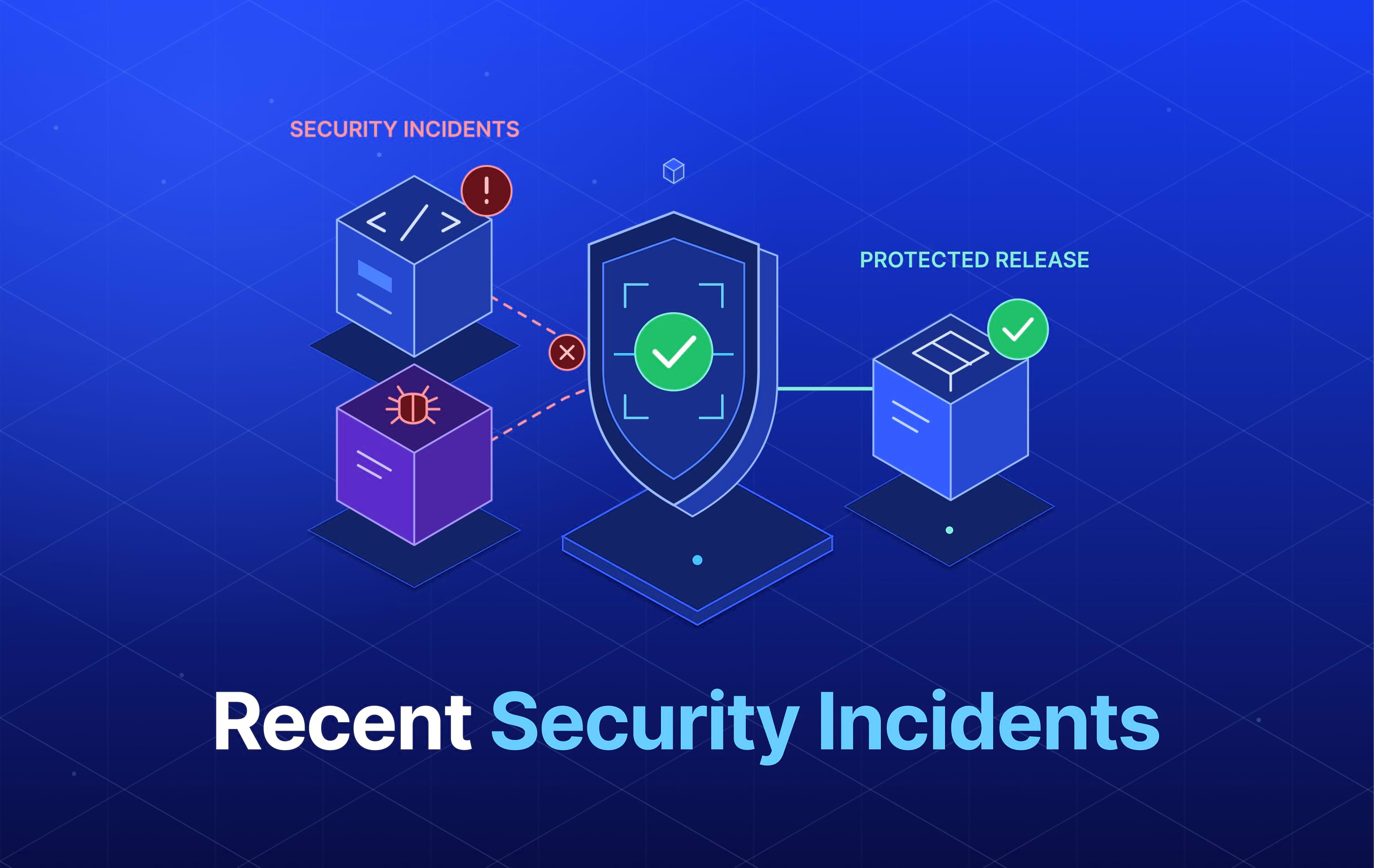

PHP2Shell, LiteLLM, React, Node.js, eMudhra, GitLab, and PyTorch reveal different paths into the software supply chain
A vulnerable PHP runtime can expose a website before its application code runs. A compromised AI gateway release can steal the credentials it needs to operate. An outdated certificate bundle can undermine an otherwise encrypted connection. October’s security disclosures show how much enterprise exposure sits inside the open source software and trust infrastructure that applications inherit.
Most of the events below emerged during October 19–25, with the related Next.js and React update released October 14. They include confirmed software vulnerabilities, a malicious release, a certificate authority failure, and a research demonstration. Those distinctions matter because each requires a different response.
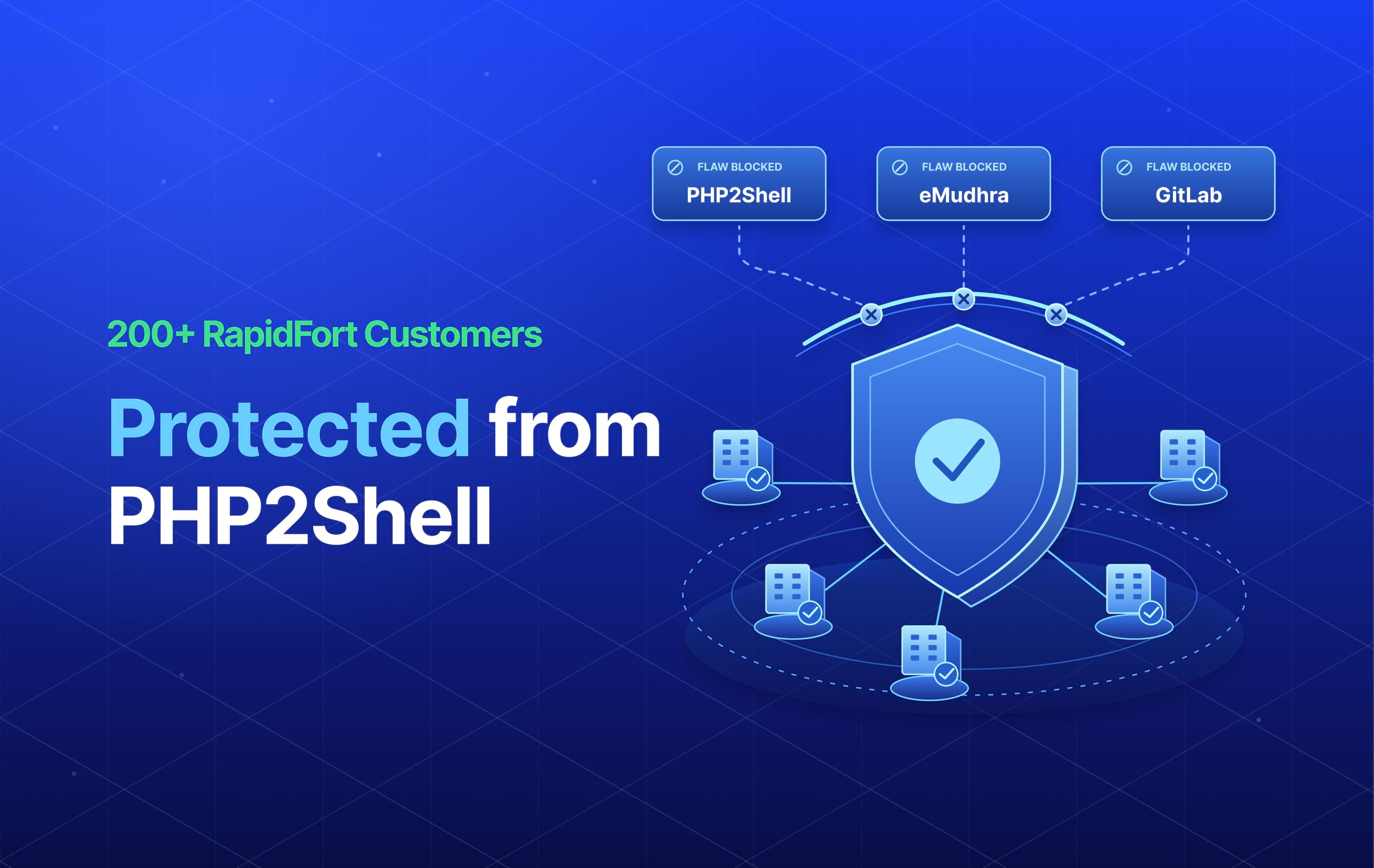
RapidFort starts with image replacement: deploy patched near-zero CVE images and trusted libraries containing the required fixes, then profile execution and remove unnecessary components to reduce the attack surface. Continuous runtime monitoring helps teams track changes after deployment. For the CVE-bearing software covered here, RapidFort provides patches. Teams easily apply those fixes to the actual component in use, including dependencies installed above the base image. Over 200 RapidFort customers have been able to quickly protect themselves by deploying RapidFort Images.
The exploitation scenarios below are illustrative examples based on the disclosed conditions. They are not claims that these specific attacks occurred.
How does PHP2Shell expose the runtime beneath the website?
PHP’s October 21 security release addressed CVE-2026-109618 and CVE-2026-109619. One involves corruption during cleanup after an out-of-memory condition; the other involves request-owned state surviving after its memory has been freed and being reused by a later request. Both can allow unauthenticated remote code execution. PHP identified web-serving installations as at risk, with demonstrated exploitation before application code runs in mod_php. (PHP security advisories and October 2026 releases)
This reaches beyond images named php. WordPress, Drupal, FrankenPHP, and other PHP-based application images can inherit the vulnerable runtime. Updating a content management system does not necessarily update PHP inside its container. Upstream fixes shipped in PHP 8.2.35, 8.3.36, 8.4.27, and 8.5.12. RapidFort provides these patched images and goes beyond by also including fixes in php:8.1.34 along with important variations of each of these versions. (PHP security advisories and October 2026 releases)
What are Illustrative examples of PHP2Shell exploitation scenarios?
A company updates its WordPress plugins but continues running an older container with vulnerable PHP. An attacker sends crafted requests to the public site and exploits the underlying runtime. If successful, execution with the web process’s permissions could expose application configuration and database credentials.
How does RapidFort address PHP2Shell exploitations?
Replace the affected runtime or application image with a RapidFort Image containing the PHP patches, then rebuild and redeploy. Confirm that every serving replica uses the patched artifact. Runtime profiling and hardening can remove unused components that would otherwise add exposure, while monitoring supports continued visibility. Hardening complements the PHP patch; required vulnerable PHP code must be fixed. RapidFort has also made available patched images for Drupal, Dunglas/frankenphp, Moodle, and WordPress.
How does LiteLLM show how an authentic release channel is able to distribute malware?
On October 21, attackers compromised LiteLLM’s release pipeline and published malicious version 1.107.0 artifacts to PyPI and container registries. The release contained credential-stealing malware and remote-code execution tools. Affected container tags included v1.107.0, latest, main-latest, and main-stable during the incident window. This was a malicious distribution event, without a CVE identified in the incident advisory. (LiteLLM affected artifacts and incident response)
LiteLLM’s October 23 investigation traced the attack to an exposed Agent Platform master key that had not been revoked. The attacker obtained GitHub tokens, gained organization-level access, and redirected release builds to an attacker-controlled repository. The investigation superseded earlier theories about the attack chain. (LiteLLM canonical attack-chain investigation)
What are Illustrative examples of LiteLLM exploitation scenarios?
An organization automatically deploys the latest LiteLLM gateway image. During the compromise window, that update brings malware into a service holding AI provider keys and cloud credentials. The stolen secrets could then be used against services outside the container.
How does RapidFort help mitigate these LiteLLM exploitations?
Start from verified clean artifacts and use RapidFort Curated Libraries and independently malware-scanned images to reduce the chance that compromised dependencies enter a build. A clean base image cannot protect an application that later installs a malicious package, so the entire dependency path matters. Specific detection of this payload should be validated rather than assumed. If compromised artifacts run, replacing them must be accompanied by credential revocation, rotation, and investigation; no image patch can recover a stolen secret.
How do the React framework vulnerabilities reach application dependencies?
The October 14 Next.js update addressed two critical remote code execution issues. GHSA-673q-mjm6-r5xr concerns use cache functions returning typed arrays, with related upstream React advisory GHSA-xqc2-xf4c-x3h3. The second, CVE-2026-96889, concerns SVG processing through an upstream image library on glibc-based Linux. The update also addressed a high-severity Server Actions denial-of-service issue. (Next.js security update for upstream vulnerabilities)
Next.js released fixes in 15.5.28 and 16.4.1. The cache advisory did not list a CVE when reviewed. These issues should be tracked separately from Node.js TLS flaws, and exposure depends on the application’s framework version, dependencies, and features. (Next.js security update for upstream vulnerabilities)
What are illustrative examples of React exploitation scenarios?
A Next.js application processes attacker-controlled SVG content through an affected image-processing path. A crafted image triggers memory corruption in the vulnerable library. A successful exploit could execute within the application process and access data available to it.
How does RapidFort address these React exploitations?
RapidFort supplies patches for supported versions of CVE-bearing components, including the affected image-processing software. Apply the fixed component wherever the application obtains it, then rebuild. For the separately tracked cache issue, incorporate the patched Next.js and React dependencies identified by the upstream advisories. A curated Node.js base image secures the runtime it supplies; application-installed packages still need their own fixes. Profiling and hardening can further reduce unnecessary software around the application.
How does Node runtime combine decompression risk with TLS validation failures?
Node.js’s October 21 release included CVE-2026-111497, a Brotli decoder out-of-bounds write that can cause crashes, memory disclosure, or remote code execution when applications decompress attacker-controlled data. It also addressed TLS hostname-verification flaws: CVE-2026-105483 and CVE-2026-106069, involving unusual representations of IP addresses. (Node.js October 21 security releases)
The Brotli issue and CVE-2026-106069 affect Node.js 22.x, 24.x, and 26.x; CVE-2026-105483 affects 24.x and 26.x. A related medium-severity TLS issue, CVE-2026-106072, also concerns noncanonical IP spellings. The exact connection path and platform determine whether a bypass is reachable. (Node.js October 21 security releases)
What are illustrative examples of Node runtime with TLS validation exploitation scenarios?
A Node.js ingestion service accepts compressed external data. An attacker supplies malformed Brotli content that reaches the vulnerable decoder. Separately, a service using an affected TLS path could accept a certificate that does not correctly authenticate its destination when unusual IP notation is involved.
How does RapidFort fix the Node runtime with TLS validation exploitations?
Replace affected Node.js runtimes with RapidFort Curated Images containing the patches, rebuild dependent applications, and redeploy. Check for additional runtimes bundled inside applications so an updated base image does not leave another vulnerable copy behind. Hardening reduces unused supporting software; the decoder and TLS fixes address the flaws in code the service still needs.
How do eMudhra weak keys undermine certificate trust?
On October 20, Google disclosed compromised private keys associated with eight eMudhra intermediate CA certificates. Insufficient randomness made the keys recoverable and enabled forged HTTPS certificates against clients that still trusted the affected authorities. This was a certificate trust failure rather than a single CVE-bearing package flaw. (Google response to compromised eMudhra intermediate CAs)
Browsers can distribute emergency blocks, but containerized applications may use OS certificate bundles, language-specific stores, or embedded trust data. Google reported that its Certificate Transparency enforcement limited opportunities to use fraudulent certificates against protected clients. That protection should not be assumed for every server-side client. (Google response to compromised eMudhra intermediate CAs)
What are illustrative examples of eMudhra weak keys that undermine certificate trust exploitation scenarios?
An attacker able to intercept a service’s network traffic presents a forged certificate chaining to an affected CA. A client retaining the vulnerable trust chain and lacking effective blocking could accept the connection, allowing interception of credentials or data.
How does RapidFort help mitigate eMudhra weak keys that undermine certificate trust exploitations?
Use updated RapidFort Images and verify that their OS and application trust stores remove or distrust the compromised chains. Rebuild applications that ship independent certificate bundles. Because this incident has no single CVE, its remediation requires explicit trust-store validation in addition to ordinary vulnerability patching. Organizations serving certificates under affected hierarchies must also replace those certificates as required; container updates cannot perform that operational step.
How does GitLab place the software delivery system at risk?
GitLab’s October 21 critical release fixed CVE-2026-110264, a CVSS 10.0 integer overflow in regular-expression compilation. Under certain conditions, a crafted expression could let an unauthenticated attacker execute code on a GitLab server. The issue affects Community and Enterprise Editions across multiple release lines. (GitLab October 21 critical patch release)
Fixed versions include 18.11.13, 19.0.10, 19.1.9, 19.2.9, 19.3.6, 19.4.3, and 19.5.1. GitLab stated that GitLab.com was patched and urged self-managed installations to upgrade. Teams should assess their server application images, including gitlab/gitlab-ce and gitlab/gitlab-ee. (GitLab October 21 critical patch release)
What are illustrative examples of Gitlab placing software delivery systems at risk?
A self-managed GitLab instance remains exposed while its upgrade awaits a maintenance window. An attacker reaches the vulnerable compilation path and gains server-side execution. Depending on permissions and configuration, that foothold could expose source repositories or credentials and provide an opportunity to tamper with future releases.
How does RapidFort help to mitigate the issue of Gitlab placing software delivery systems at risk?
Deploy the patched GitLab application components supplied through RapidFort remediation coverage for supported versions, following GitLab’s required upgrade path. The fix must reach GitLab’s vulnerable component; replacing an underlying Linux base alone is insufficient. Runtime profiling and hardening reduce unnecessary tools around the service. If exploitation is suspected, investigate repository integrity, tokens, and release artifacts alongside the upgrade.
What is PyTorch research that raises the question about trusted training code?
On October 20, researcher Elon Litman described a PyTorch backward-pass technique in which a crafted loss term reports zero while influencing gradients and driving computation through model weights. The demonstration exploits a mismatch between floating-point evaluation and automatic differentiation. (Elon Litman backward-pass research)
This should be described as research, not a confirmed production compromise or vendor-validated host-level remote code execution vulnerability. No confirmed CVE was identified for this specific technique. The threat model requires attacker-influenced training logic, such as a malicious regularization dependency. (Elon Litman backward-pass research)
What are illustrative examples of trusted training code risks raised by PyTorch?
An ML team adds an unfamiliar training optimization package. Its loss contribution appears harmless in dashboards but manipulates gradients during fine-tuning. Training metrics alone may fail to reveal the unwanted computation or weight changes. This scenario does not establish a container escape or operating-system takeover.
Reduce exposure before the next disclosure
These events require action at different layers. PHP and Node.js need patched runtimes. Next.js and GitLab require fixes inside the application stack. LiteLLM requires clean artifacts and credential recovery. eMudhra requires trust-store changes. PyTorch’s research case calls for scrutiny of the code shaping training behavior.
RapidFort starts by replacing vulnerable software with patched near-zero CVE images and trusted libraries. Runtime profiling then identifies what applications actually execute so teams can remove unused components, and continuous monitoring helps track subsequent changes. (RapidFort Platform Capabilities, RapidFort Curated Libraries)
For security and platform teams, the practical goal is to close the gap between a published fix and the software serving production traffic. Check running image digests, rebuild the dependencies above the base image, and confirm that the replacement reached every affected workload. A patched artifact in a registry only reduces production exposure once it is deployed.
Request RapidFort access at https://www.rapidfort.com/request-access to identify affected images and plan replacement with patched, curated alternatives.
Latest posts




Eliminate Attack Vectors at the Source
Continuously eliminate up to 99.9% of CVEs without code changes


Products
Use Case
Quicklinks
Address
440 North Wolfe Road, Sunnyvale, CA 94085


Stay in touch
Subscribe for product updates and RapidFort newsletter.
© 2026 RapidFort, Inc.
RapidFort, RAPIDFORT, and RBOM® are registered trademarks of RapidFort, Inc. All other marks and names mentioned herein may be trademarks of their respective companies.