
For a containerized cloud service, FedRAMP readiness is decided largely inside the container images. Most vulnerabilities are inherited from base and third-party images, and those same images must carry FIPS-validated cryptography, pass STIG configuration checks, and produce evidence every month.
The bar is also rising. FedRAMP will make its Vulnerability Detection and Response (VDR) and Vulnerability Evaluation and Reporting (VER) rules mandatory on December 7, 2026, to align with CISA Binding Operational Directive (BOD) 26-04. FedRAMP has stated that the legacy monthly scanning process most Rev5 services follow is no longer sufficient on its own.
This paper lays out six sequential steps that take a container estate from today's vulnerability backlog to a sustainable, audit-ready state.
RabbitMQ
NGINX Ingress
Kyverno
Keycloak
...
ASP.NET
.NET SDK
Go
JDK Corretto
Node.js
Python
FIPS across all first- and third-party images.
Verify config and report in monthly self-attestations.
Remove unused files to cut attack surface and remove unpatchable CVEs.
Fewer future CVEs from a smaller attack surface.
Lower infra cost, faster boot.
Produce monthly aggregate reports.
Remediate at the OS and application level.
~10% new CVEs per month on average (100+ Critical and High CVEs per month in a typical application)
Monthly reporting and self-attestation: remediate all High and Critical CVEs and maintain STIG compliance
RabbitMQ
NGINX Ingress
Kyverno
Keycloak
...
ASP.NET
.NET SDK
Go
JDK Corretto
Node.js
Python
FIPS across all first- and third-party images.
Verify config and report in monthly self-attestations.
Remove unused files to cut attack surface and remove unpatchable CVEs.
Fewer future CVEs from a smaller attack surface.
Lower infra cost, faster boot.
Produce monthly aggregate reports.
Remediate at the OS and application level.
~10% new CVEs per month on average (100+ Critical and High CVEs per month in a typical application)
Monthly reporting and self-attestation: remediate all High and Critical CVEs and maintain STIG compliance
A typical enterprise container estate begins FedRAMP preparation with thousands of open CVEs, and the backlog grows every month. Manual patching does not scale against that curve. RapidFort estimates that about 88% of vulnerabilities are inherited from base images and dependencies rather than custom code, and that the average remediation cycle runs about 12 days.
CVEs across the top 50 images
Critical / High findings in those images
images needing FIPS-validated variants
footprint of ~90 containers, much of it unused
The six steps that follow address these areas in sequence. Each step reduces the work left for the next one.
Swapping open-source and vendor images for curated equivalents removes the largest block of inherited CVEs with no code changes. Third-party images are the software you run but do not build: identity (Keycloak), messaging and streaming (Kafka, Kafka Connect, Flink operators), observability (Fluentd, node-exporter), and cluster tooling (cert-manager, KEDA, kubectl). They often carry the most CVEs because you cannot patch them at the source.
RapidFort Images are curated drop-in replacements. They keep the original components, size, and major/minor version tags; a patched image simply no longer lists the fixed CVEs. The catalog covers more than forty thousands images across Ubuntu, Red Hat UBI, Debian, Alpine, Oracle Linux, and Amazon Linux, and images are rebuilt at least twice a week.
1. Inventory and baseline. List every third-party image in your registries and Helm charts, and scan each to record its starting CVE count.
2. Find the curated match. Search the catalog by repository, then filter by version and OS.

3. Swap the image reference. Update the tag in your Helm values or manifests. Use Bitnami-compatible (bnt) variants where your charts expect them.
4. Verify signature and provenance at ingestion, before the image enters your internal registry.
5. Rescan, compare, and pin by digest, so admission control (Kyverno or Gatekeeper) only admits signed, approved images.
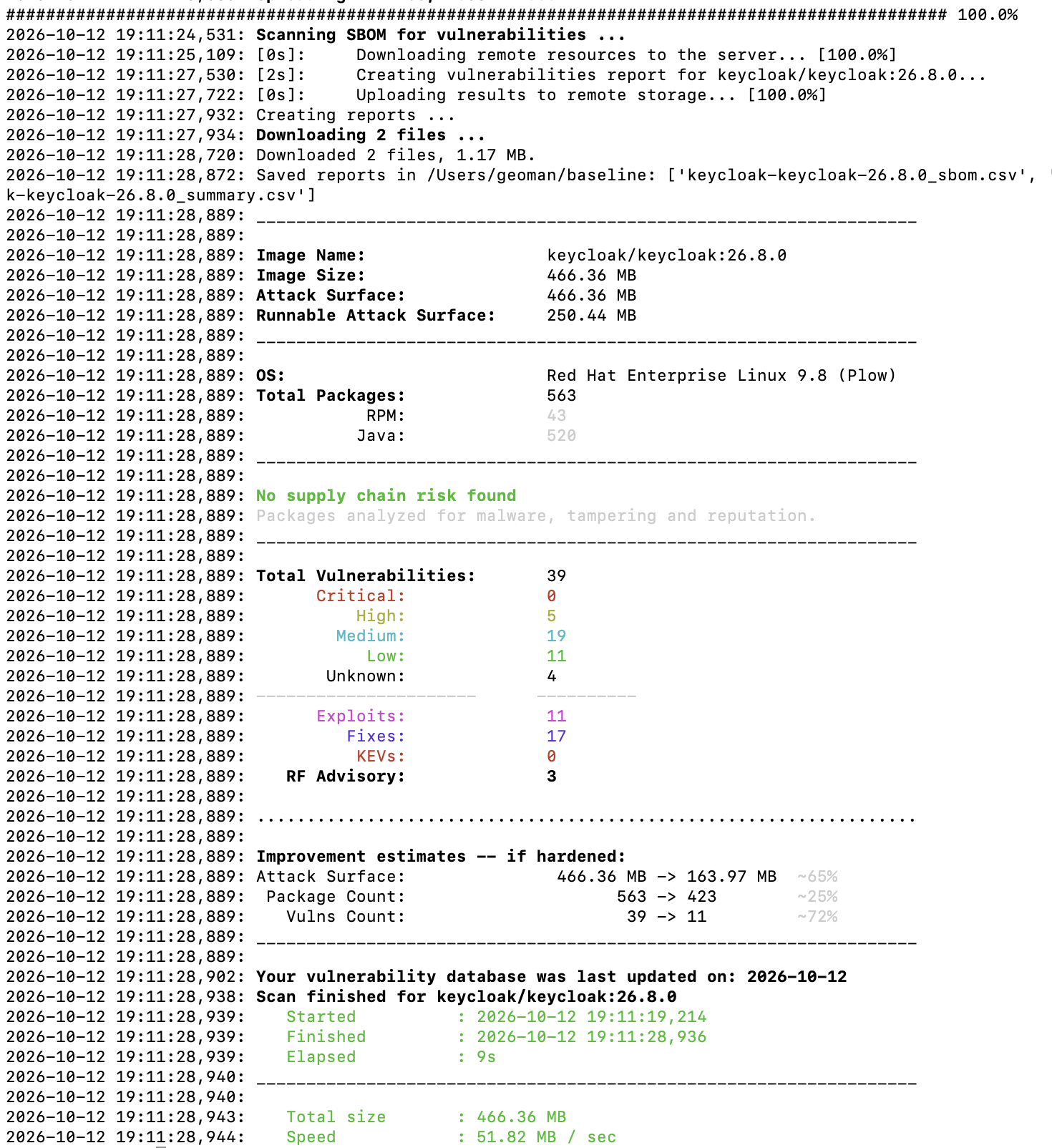
Here is the dashboard output of the project called “FedRAMP baseline” comparing Keycloak:26.8.0 with 39 CVEs on the left hand side compared to the RapidFort Keycload:26.8.0 down to 0 CVEs on the right. This kind of platform dashboard is critical to show you results of daily scans and available alternatives from curated catalogs of near zero CVE alternatives.
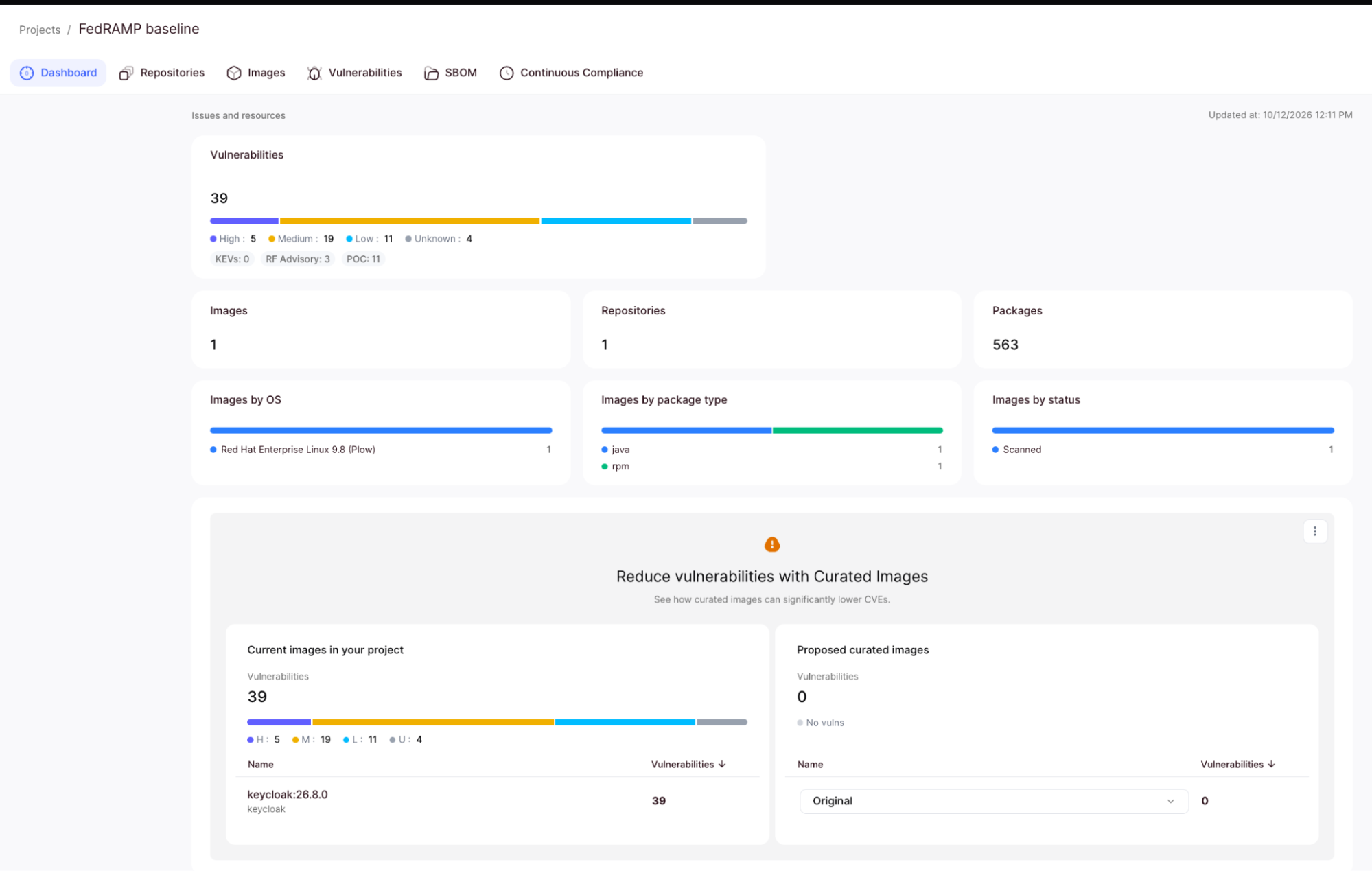
New curated images are built daily. Check your compliance dashboard regularly and upgrade to the latest version to stay ahead of newly disclosed CVEs. Typical SLAs are shown below.
RapidFort standard targets, measured from upstream patch availability; your commercial agreement governs. FedRAMP clocks start at CVE discovery, which is tighter, so build that gap into your plan.
Your own applications inherit most of their CVEs from the base image in their FROM line, so rebasing them on curated framework images is usually a one-line change per Dockerfile. First-party images are the services your teams build and maintain: public APIs, internal services, data-access layers, and webhooks. Rebuild them on curated .NET, Node.js, Java/JDK, Python, Alpine, Oracle Linux, or Ubuntu bases; you keep your existing OS family and language stack.
Baseline: Build the current Dockerfile as-is and record the CVE count with rfscan.
Find the matching base: Use rfcatalog to locate the same runtime and OS, for example rfcatalog -r python -iv 3.13 -t jammy. Confirm the exact, fully patch-versioned tag before committing it.
Swap every relevant `FROM` line, including build stages in multi-stage Dockerfiles.
Rebuild, test, and rescan against the baseline.
Gate the pipeline so regressions cannot ship. rfscan exits with code 2 when thresholds are exceeded, and a Dockerfile linter such as Hadolint can reject any FROM outside your trusted registry.
Illustrative; results vary by image and application. A 60%+ reduction from the base swap alone is common. Tags roll forward frequently, so treat any tag in this paper as an example.
Every image that encrypts, signs, hashes, or terminates TLS for federal data must use FIPS-validated cryptographic modules. The fastest route is to move those workloads to FIPS-tagged curated images rather than building and maintaining FIPS toolchains yourself. In the assessment above, about 40 images needed FIPS variants, spanning identity, APIs, messaging, and cluster webhooks.
FIPS 140-3 validated OpenSSL providers, covering downstream consumers such as cURL.
BouncyCastle FIPS injected at startup; the app will not start if it fails to load.
Every FIPS image is tested with the FIPS kernel enabled.
strict-fips variants hard-fail if a non-FIPS algorithm is called.
Map crypto boundaries: List each service that uses cryptography and the library it calls (OpenSSL, Java JCE, Go crypto, language-native libraries).
Select FIPS variants: The fips tag means the image's cryptographic boundary maps to a module certificate in NIST's CMVP database.
Configure the application: FIPS images do not automatically force strict FIPS mode in your app. Set approved algorithms, cipher suites, and TLS settings explicitly, or use strict-fips images to enforce it.
Run on FIPS-enabled hosts: Container cryptography relies on the host kernel.
Test for non-approved algorithm calls, ideally with the strict variant in staging, before production cutover.
Record module certificates in your System Security Plan, mapping each image to its CMVP certificate.
Evaluate random-number-generator requirements separately; FIPS images do not cover them automatically. NIST's CMVP is transitioning from FIPS 140-2 to FIPS 140-3, so confirm the current status of each certificate you cite.
Profiling and optimization removes the code your application never executes. That eliminates CVEs with no upstream patch and lowers the odds of future ones. Curated images fix what can be patched; optimization removes unused shells, package managers, debug utilities, and libraries that are present but never loaded. Fewer components also mean fewer new CVEs each month, which keeps the Step 6 reporting burden flat.
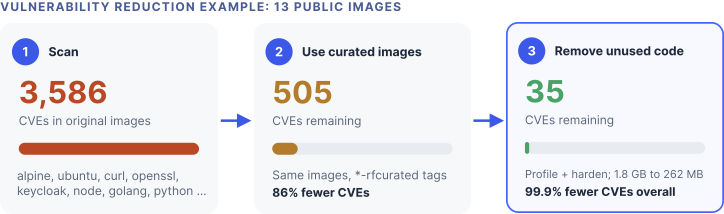
Adapted from the RapidFort vulnerability reduction example in the FedRAMP remediation roadmap.
Attack surface reduction up to 90% on well-profiled workloads.
Image size reductions of 40–80%; in the assessment above, the estimated footprint of about 90 containers fell from roughly 20 GB to 6 GB.
Lower infrastructure cost and faster container start-up.
Instrument the image. rfstub injects profiling instrumentation and appends -rfstub to the name. Use -s bpfwrap on ARM or macOS.
Exercise the application in test, QA, or staging, ideally with your automated test suite. Anything not observed is removed later.
Watch and snapshot (optional). rflens streams live file activity; rfrbom captures the Runtime Bill of Materials (RBOM®) of what actually runs.
Optimize with a preset that matches your risk tolerance.
Pin hard-to-exercise paths with a profile file (rfharden myapp-rfstub -p profile)instead of re-testing. A hardening profile (profile file) is a list of entries naming the components that should always be retained in a hardened image, even if runtime profiling didn’t detect them as used.
Reuse profiles across releases with -t <workload-tag> when functionality in your application has not changed and you don’t need to rerun a full test cycle.
Once images are clean, FIPS-enabled, and minimized, benchmark them against DISA STIG profiles and either remediate or formally document every failing rule. Running STIG last on hardened images means fewer rules to fix and fewer deviations to justify. STIGs check configuration, not CVEs. Assessors expect a repeatable scan, a remediation record, and a documented rationale for each rule you do not apply.
Start from STIG-hardened bases where available: RapidFort publishes STIG-hardened images for Ubuntu, Red Hat UBI, and Amazon Linux.
Find the right benchmark profile and scan each image against it, attaching results to a compliance project.
Remediate: Generate a remediated Dockerfile with -a, or apply your own script with -r remediation.sh, then rescan.
Tailor and document deviations: Remove rules that do not apply to containers with a tailoring file (-t tailor.json), and record each justification in your System Security Plan or deviation log.
Scan hosts too with rfcat --scan-host for the nodes that run your workloads.
Re-run on every rebuild so drift is caught before release. CIS benchmarks are also available through rfcat if your agency sponsor accepts them.
Steps 1–5 get you clean; Step 6 keeps you clean and proves it every month. FedRAMP's VDR rules require providers to report vulnerability detection and response activity to all necessary parties at least monthly, in a consistent, human-readable format.
Automate these in CI/CD with a service account so the package builds itself on a schedule. RF Advisory determinations provide evidence-backed false-positive records, which reduces the findings you must carry and explain.
Monthly reports show where you were; FedRAMP's new rules require you to know, per finding, how much time you have left. CISA issued BOD 26-04 on June 10, 2026. It replaces CVSS-driven patch schedules with deadlines based on four risk factors, some as short as three days.
FedRAMP responded in Public Notice NTC-0014 by making its VDR and VER rules mandatory for every cloud service obtaining or maintaining certification on December 7, 2026. Services not following them can stay certified under a corrective action plan only through March 7, 2027; after that, certification is revoked.
Is the asset publicly reachable?
Is the CVE in CISA's KEV catalog?
Can exploitation be automated? Assume yes without evidence.
Total or partial control after exploitation?
Source: CISA BOD 26-04 These are maximums; FedRAMP expects providers to move faster.
Because VER-EVA-AIA treats every finding as automatable by default, an exposed KEV finding should be handled as a 3-day item unless you can prove otherwise. A BOD 26-04 dashboard turns the matrix into a live, per-finding view. At minimum it should:
Record all four factors for every finding on every asset, with the evidence behind each answer.
Calculate the deadline automatically and show days remaining, starting the clock at discovery.
Flag 3-day items, especially those requiring forensic triage, the moment a CVE is added to KEV.
Track mitigations that change the clock, such as removing internet exposure, separately from full remediation.
Separate accepted vulnerabilities and evidence-backed false positives from open work.
Export the monthly human-readable report and the machine-readable data FedRAMP increasingly expects.
The earlier steps make this dashboard manageable. Curated, hardened images leave far fewer findings to track, and RapidFort scan data already supplies KEV status, exploit availability, and false-positive determinations as inputs.
The dashboard described in the previous section is already available as part of RapidFort Continuous Compliance. RapidFort Continuous Compliance is a BOD 26-04–aligned capability in the RapidFort Platform that gives every container CVE its own live remediation clock. It combines CISA KEV and Vulnrichment data, refreshed every 15 minutes, with operator-defined exposure to score each finding against the directive’s four risk signals and sort it into one of five tiers: from three days plus forensic triage to next system upgrade. Tiers, deadlines, and SLA status recalculate whenever risk changes, across scanned images and running workloads. Every determination links to its source evidence, and remediation is one step away through curated near-zero CVE images and automated hardening.
RapidFort Continuous Compliance delivers the following benefits:
Precise Risk Prioritization: Identifies the critical subset of CVEs that actually trigger a 3-day BOD 26-04 remediation clock, ensuring triage efforts focus on real risk rather than inherited noise.
Defensible Compliance: Replaces subjective SLA debates with transparent, CISA-sourced evidence (combining KEV, Vulnrichment, and runtime exposure) that auditors, AOs, and reviewers accept.
Streamlined Audits & Faster ATOs: Automatically generates continuous audit evidence and reporting-ready exports aligned with CISA's standardized data schema, accelerating FedRAMP, ATO, and cATO cycles.
Backlog Reduction via Elimination: Pairs live compliance clocks with direct remediation paths such as curated near-zero CVE images and automated hardening allowing teams to retire clocks by removing vulnerable components entirely.
Unified Build-to-Runtime Model: Applies consistent risk scoring across CI/CD, registries, curated images, and live container instances so your security posture remains accurate as workloads drift.
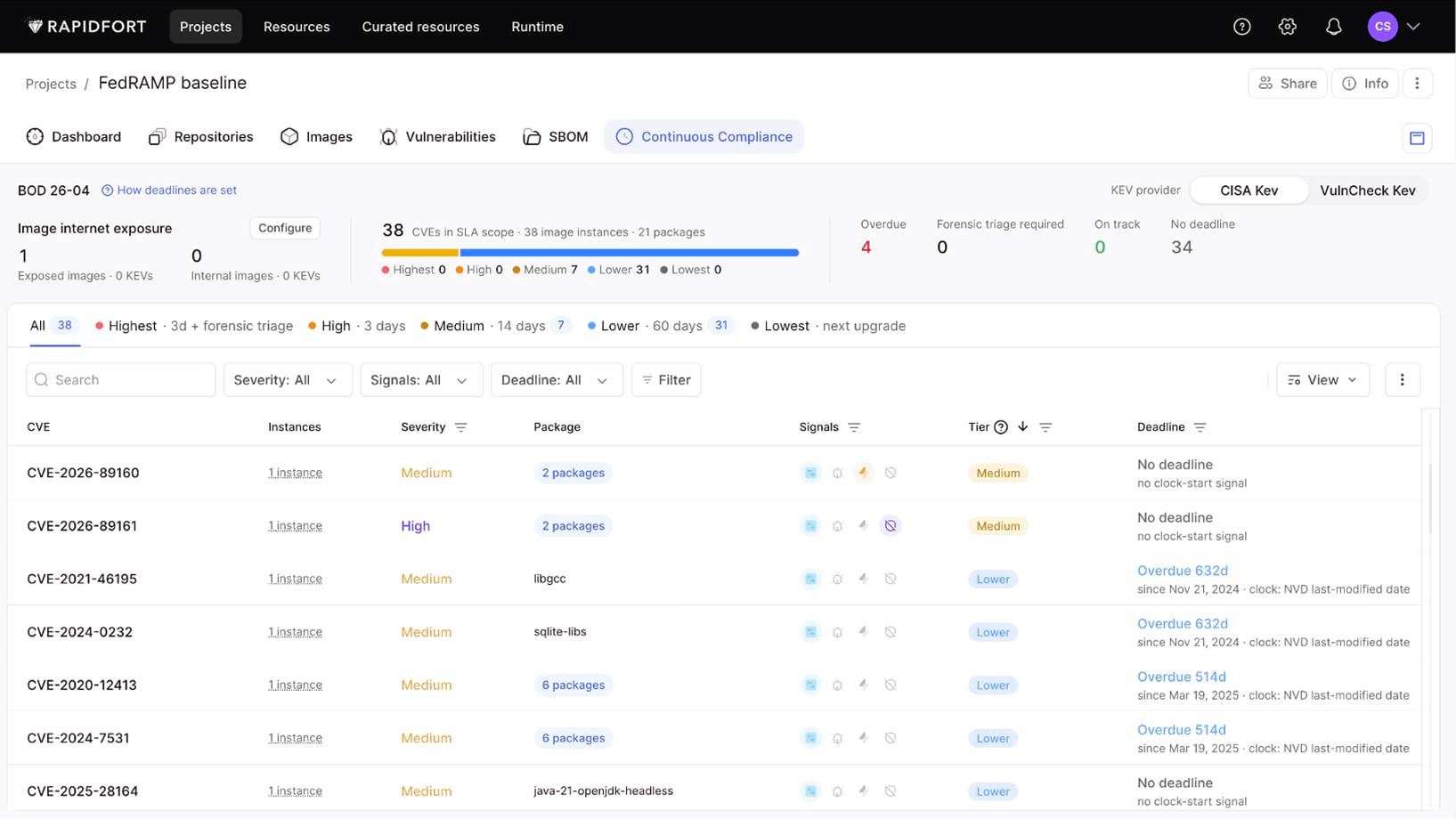
RapidFort Continuous Compliance dashboard example
RapidFort Runtime extends the RapidFort Platform beyond build-time optimization by deploying lightweight eBPF and ptrace instrumentation into live production containers to observe actual software behavior without requiring code changes. As a core component of the end-to-end security suite - bridging intake, build, and runtime - Runtime addresses the critical security gap where production environments constantly drift due to hourly CVE disclosures, package updates, and unmonitored process changes. By continuously capturing execution evidence, it establishes a reliable runtime baseline and generates a dynamic Runtime Bill of Materials (RBOM®), ensuring organizations have real-time visibility into what is actively executing across their live environments.
For organizations pursuing or maintaining FedRAMP authorization, RapidFort Runtime delivers essential audit-ready evidence and automated continuous monitoring required by rigorous federal standards like BOD 26-04 and NIST guidelines. By proactively detecting runtime tampering, correlating newly disclosed vulnerabilities with deployed workloads, and eliminating false positives through direct execution profiling, Runtime drastically reduces manual compliance overhead. This continuous validation empowers security teams to maintain a hardened posture, substantiate their continuous monitoring deliverables, and accelerate authorization cycles without slowing down software delivery.
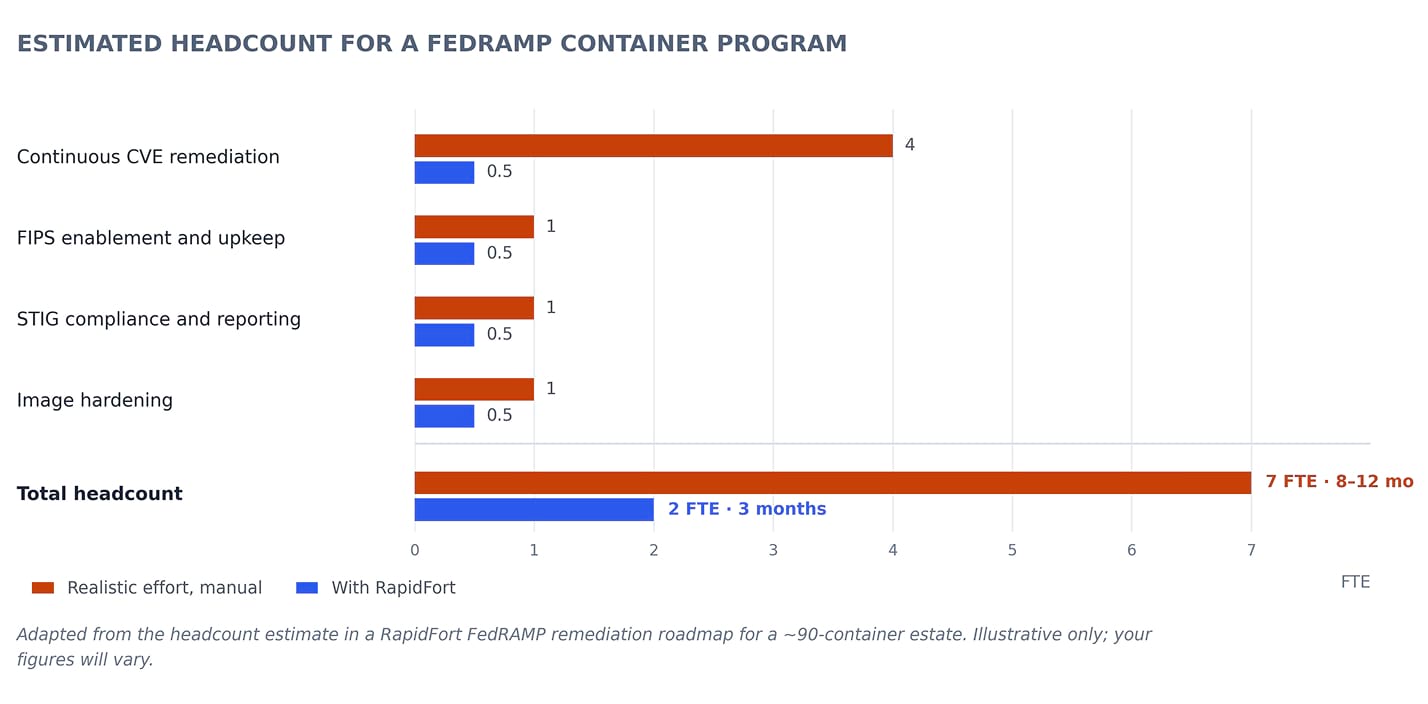
Run the steps in order and plan backward from December 7, 2026. Steps 1 and 2 deliver the largest CVE reduction fastest; Steps 3–5 close the compliance gaps; Step 6 keeps the result current. Together they shrink the team a FedRAMP program needs.
Inventory every first- and third-party image in the authorization boundary and record baseline CVE counts.
Replace third-party images with curated equivalents and verify signatures and provenance.
Rebase first-party Dockerfiles on curated framework images and add CI threshold gates.
Identify crypto-handling services, move them to FIPS variants, and record CMVP certificates.
Profile and harden images, starting with the services carrying the most CVEs.
Run STIG benchmarks on images and hosts; remediate or document every deviation.
Automate the monthly CVE, SBOM, and STIG evidence package.
Stand up a BOD 26-04 dashboard tracking all four factors and deadlines per finding.
Confirm the plan with your 3PAO and agency sponsor before December 7, 2026.
Confirm Continuous compliance dashboard and export of artifacts for monthly self attestation.
FedRAMP readiness for containers is not a one-time cleanup. It is a disciplined, sequential program: start from curated images, rebuild your own applications on clean bases, add validated cryptography, strip what you do not use, prove secure configuration, and report continuously. With BOD 26-04 and FedRAMP's new vulnerability rules compressing deadlines to as little as three days, the organizations that succeed will be those that reduce their finding volume first and automate their evidence second.
RapidFort enables this model end to end, so security and development teams can meet federal requirements without slowing delivery.
FedRAMP NTC-0014: FedRAMP Response to CISA BOD 26-04 (June 16, 2026)
CISA BOD 26-04: Prioritizing Security Updates Based on Risk (June 10, 2026)
Henry J. Sienkiewicz: Self-Published STIGs Are Not a Breakthrough - They’re a Breakdown (LinkedIn, November 2, 2025)
RapidFort Customer Guide, v2.1 (September 2026): capabilities, commands, results, and service levels
RapidFort results vary with your baseline and profiling coverage. Service levels are governed by your executed agreement. Federal requirements change often; confirm against current FedRAMP and CISA publications.

RapidFort is the leader in Software Supply Chain Security, enabling organizations to eliminate risk across their software stack at scale. Its platform combines curated near-zero CVE container images, runtime profiling, and attack surface management to remove up to 99.9% of vulnerabilities within hours and reduce the attack surface by up to 90%, without code changes. RapidFort appears in the inaugural Gartner® Magic Quadrant™ for Software Supply Chain Security and is a Gartner® Cool Vendor™ and Nutanix Global Cloud Native Partner of the Year.
© 2026 RapidFort, Inc.


