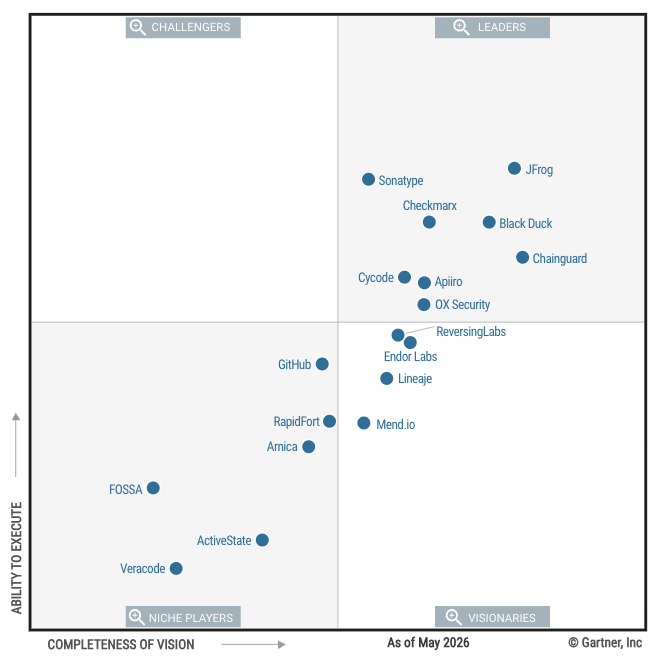
How to Patch AI-Found CVES Without Causing an Outage
November 23, 2026. Microsoft has addressed more than 1,200 software vulnerabilities so far this month, nearly 20 times as many as in the same month a year ago, according to Qualys data reported by Reuters. Patching AI-found CVEs at that volume has been linked to production outages. Microsoft CEO Satya Nadella blamed the recent outages, including Microsoft’s own, on the rush to patch vulnerabilities that AI uncovered, and the White House pointed to patching rather than an attack.
For CISOs and platform leaders, patch velocity is now an availability risk as well as a security metric. This article covers what officials said caused last week’s outages, why emergency patches break production, and how to patch container images and open source packages without changing the software you run.
What officials say caused last week’s outages
Between November 12 and 17, outages hit Microsoft 365, the FAA, Workday, Chase, United Airlines, the NSA, and Apple. The Wall Street Journal reported that more than 450 million Microsoft 365 users couldn’t send or receive email on the first day, and described the patches for AI-found flaws as coming in “fast…and messy.”
On November 18, the White House released remarks from Director of National Intelligence Jay Clayton and Secretary of State Marco Rubio saying there’s no sign of a coordinated cyberattack. Clayton attributed the disruptions to institutions patching newly identified vulnerabilities and upgrading legacy systems, calling it “an upgrade in patching, an upgrade in systems.” A spokesperson for Sen. Mark Warner told Fortune that botched implementation of AI-driven patches was linked to the NSA outage and to the bank outages.
The Washington Sun reported, citing three anonymous sources, that bank executives and the NSA gave members of Congress the same explanation in private conversations. A congressional official briefed on the matter described teams pushing through patches all at once, “more than the system was designed for.”
The causes aren’t identical. A JPMorgan Chase spokesperson told Fortune its outage came from a software bug in on-premises hardware that wasn’t found or fixed with AI, and Clayton told a House Homeland Security Committee hearing that there’s no indication the outages are related, according to Reuters. What the incidents share is the pressure behind them: more critical fixes to ship in less time.
Why emergency patches break production
Security fixes change the components everything else depends on. Yuval Itzchakov, CTO of A Security, told Reuters that emergency patches reach core infrastructure within hours, often without a full testing cycle, and that they alter runtimes, kernels, and network components. When patch volume rises 20-fold, the testing window shrinks with it.
Containers have their own version of this problem. Fixing a CVE in a base image often means pulling a newer image, and that image can bring a different glibc, OpenSSL, or language runtime minor version along with the fix. Teams that switch to a different distribution to get a cleaner image take on a migration, with new package names, new file paths, and new behavior to retest. Under deadline pressure, that migration is where outages start.
Cliff Steinhauer of the National Cybersecurity Alliance described the same squeeze to Fortune: the volume of fixes pushes staff to apply changes that can break things, and there isn’t time to fully test every update.
Patch pressure is still building
The flow of fixes didn’t stop when the outages did. On November 19, the PHP project released patches for 18 vulnerabilities, seven rated critical, its second major security release in about a month after the PHP2Shell fixes in October. Clayton told Fox Business that the NSA outage was caused by patches for recently discovered PHP vulnerabilities, which Gizmodo notes Reuters reported were found with AI.
Nadella said Microsoft had already applied at least three critical patches on the day he spoke at the DealBook Summit, and VulnCheck counts 100,000 publicly disclosed CVEs so far in 2026, according to Reuters. Steinhauer expects discovery to peak and then decline as organizations fix the underlying issues in their code, but no one has put a date on that peak.
How to patch container images without changing what you run
The safest emergency patch changes only the vulnerable code. RapidFort Images are near-zero CVE container images built on the LTS distributions you already run, patched daily, and designed as drop-in replacements that stay ABI compatible across major LTS releases. If a service runs on Ubuntu 22.04 today, it moves to the RapidFort Image of Ubuntu 22.04, with the same distribution, package manager, and file paths.
# Before: public base image
FROM ubuntu:22.04

# After: RapidFort Image, same distribution and version
FROM [INSERT RAPIDFORT REGISTRY PATH]/ubuntu:22.04
Your application code, build steps, and package installs stay the same, so the change you test is the CVE fix itself. For KEV-listed vulnerabilities, RapidFort sets a target resolution time of one calendar day, measured from the date an upstream patch is available, as described in the RapidFort glossary.
Application dependencies get the same treatment. RapidFort Libraries provide malware-scanned, pin-for-pin builds of open source packages, so you keep the exact versions in your lockfile and install them with pip or npm as you do today. RapidFort Libraries product page
You can also shorten the patch queue. RapidFort Optimizer removes components your workload doesn’t use, which can reduce software attack surface by up to 90%. A package that isn’t in the image never needs an emergency patch. Learn more on the RapidFort Images page.
What to tell your board about patch risk
After this week, boards will ask whether the same thing could happen to you. A useful answer separates two questions: how fast you can patch, and how safely. Speed depends on knowing which new CVEs affect what’s running. RapidFort Runtime monitors deployed workloads, tracks newly disclosed CVEs against the components actually loaded, and generates a runtime bill of materials (RBOM®) as audit evidence.
Safety depends on how much changes with each patch. Drop-in images and pinned libraries keep each change small. RapidFort Continuous Compliance gives every container CVE its own remediation clock aligned to the risk tiers in CISA’s BOD 26-04, so you can show the board which fixes are due, which are on track, and which you deferred on purpose. Continuous Compliance page
Regulators are asking similar questions. After the JPMorgan Chase outage, Treasury and Office of the Comptroller of the Currency (OCC) officials called banks within minutes to confirm the incident was contained and not cyber-related, and the OCC plans a deep dive to check what banks told it, according to people familiar with the matter who spoke to Reuters. OCC head Jonathan Gould called the outage “an isolated incident.” For banks and other regulated firms, a record of what changed in each patch, when, and why is now part of the incident response.
RapidFort covers containerized workloads and open source packages. It doesn’t patch network hardware, mainframes, or the SaaS tools your teams depend on. The FAA’s stated cause, a router installed during routine maintenance that was overwhelmed by network traffic according to Gizmodo, falls outside that scope.
Patch on the distribution you already run
AI-driven discovery means more CVEs to fix every month. Patching on the distribution and package versions you already run keeps each fix small enough to test and ship on deadline. Schedule a demo to see RapidFort Images and RapidFort Runtime on your own workloads.
Latest posts


Eliminate Attack Vectors at the Source
Continuously eliminate up to 99.9% of CVEs without code changes


Products
Use Case
Quicklinks
Stay in touch
Subscribe for product updates and RapidFort newsletter.
Address
440 North Wolfe Road, Sunnyvale, CA 94085


© 2026 RapidFort, Inc.
RapidFort, RAPIDFORT, and RBOM® are registered trademarks of RapidFort, Inc. All other marks and names mentioned herein may be trademarks of their respective companies.