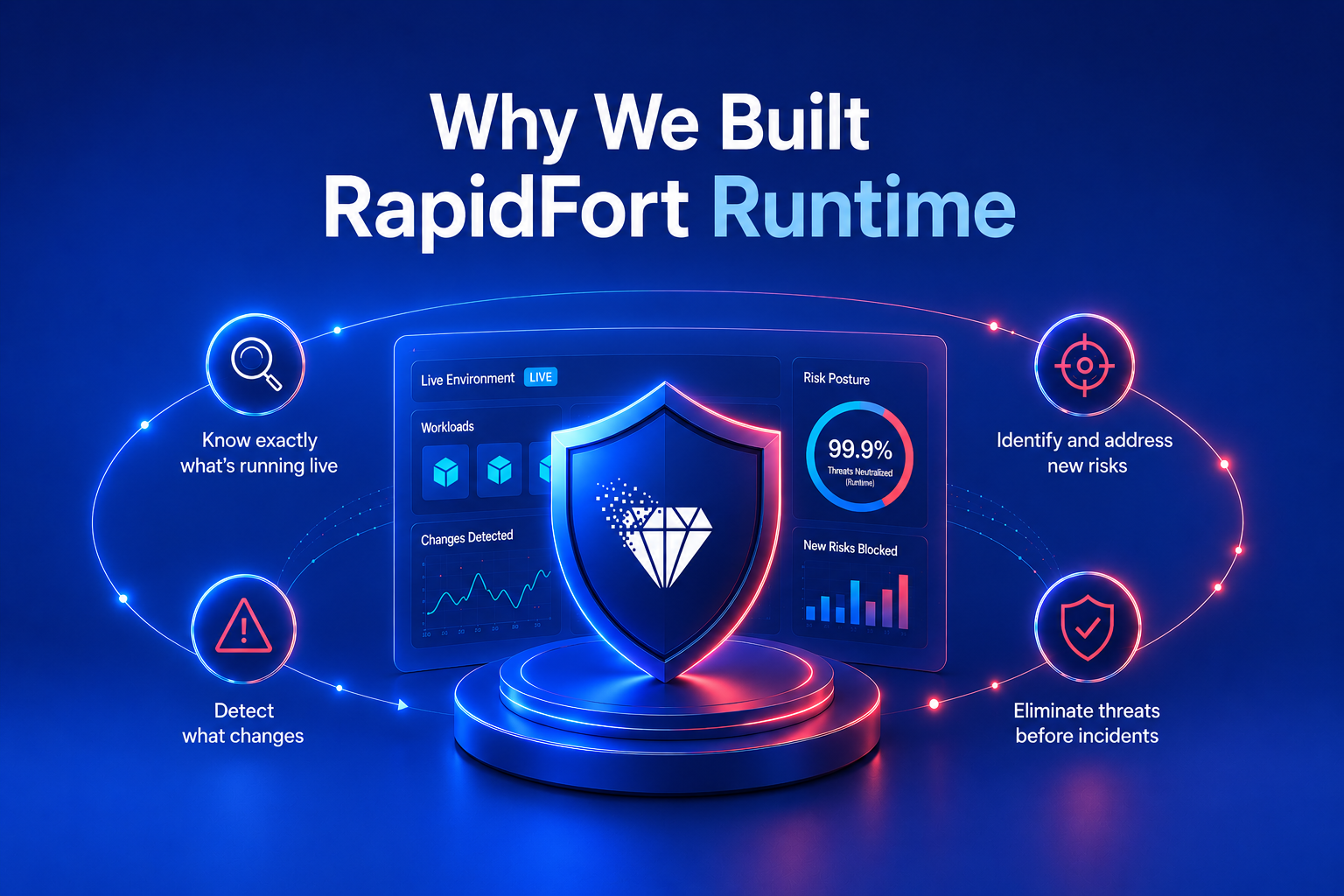
Why We Built RapidFort Runtime: Extending Software Supply Chain Security Into Live Production

Software supply chain security has traditionally focused on what happens before deployment. Security teams scan source code, container images, packages, dependencies, and software bills of materials before an application reaches production. These controls are necessary, but they only answer questions about a specific snapshot in time.
Production deployment is never a static point in time. Applications start new processes, services load additional libraries, packages are updated, dependencies are downloaded, configurations change and new CVEs are disclosed after deployment. Files can be modified, replaced, or introduced into a workload that previously passed every required security check.
The software that was approved during the build process may not be the same software that is running days, weeks, or months later. We designed RapidFort Runtime to address this gap.
RapidFort Runtime continuously observes the live production environment, builds an evidence-based record of what is executing, identifies changes to deployed software, correlates new vulnerabilities with unique production workloads, and provides the technical context needed to determine whether a newly disclosed risk actually matters.
The goal is not to create another stream of runtime alerts, but to establish a reliable technical connection between software supply chain security before deployment and software integrity after deployment.
The Limits of Static Software Inventory
A static software bill of materials (SBOM), container scan, or package inventory provides useful information about what was present when the artifact was analyzed. It does not prove what is actually executing in production.
A package can be installed but never loaded. A library can exist in an image without being reachable by the application. A process can download a dependency after startup. A binary can be replaced after deployment. A new child process can introduce software that did not exist in the original container image.
These differences matter because vulnerability scanners typically reason from software presence.
If a vulnerable package is found, the scanner reports it. The security team must then determine whether the package is even being used, whether the affected function is reachable, whether the vulnerable code is loaded, and whether the production workload is exposed.
At enterprise scale, this process creates thousands of findings that require manual correlation. Runtime evidence changes the problem. Instead of asking only, "What software was installed?" we can also ask:
- What software is executing?
- Which libraries are loaded?
- Which processes were created?
- Which system calls are being made?
- Which network connections are active?
- Which files changed after deployment?
- Which dependencies appeared at runtime?
- Did the workload's behavior deviate from its established baseline?
RapidFort Runtime was designed to collect, connect, validate, and take action on this evidence continuously.
Observing Production Without Changing Application Code
One of our primary engineering requirements was that runtime monitoring could not depend on application rewrites, proprietary language agents, or changes to the development process.
The instrumentation needed to work across containerized workloads and existing production environments while remaining lightweight and, most importantly, read-only.
RapidFort Runtime uses BPF and ptrace-based instrumentation to observe application and operating system activity. These technologies allow the platform to capture runtime evidence at the process and system level without requiring developers to modify application source code.
The collected evidence can include:
- Process creation and execution
- System call activity
- Loaded packages and libraries
- Network behavior
- Memory activity
- Runtime dependencies
- File and binary changes
- Software introduced after deployment
This creates a direct record of application behavior rather than an inferred model based only on the contents of an image or package manifest. This distinction is important because even though a static scanner can identify what might execute a runtime instrumentation can show what actually did execute.
Building a Runtime Baseline
Runtime security requires a reliable understanding of normal behavior. RapidFort Runtime establishes a baseline of approved packages, binaries, libraries, processes, dependencies, and application behavior within a production workload. The baseline becomes a reference point for identifying meaningful changes.
This is not limited to a list of filenames. A useful runtime baseline must capture relationships between software components and observed activity. A package may be present, but the more important questions are whether it is loaded, which process uses it, what behavior it enables, and whether that behavior changes over time.
The baseline allows the platform to identify events such as:
- A new package appearing inside a running workload
- A binary changing after deployment
- A previously unseen library being loaded
- A new child process starting
- A process making unexpected network connections
- Runtime dependencies being downloaded
- Application behavior diverging from the approved state
Not every change is malicious. Production systems change for legitimate reasons. The engineering challenge is to preserve the evidence required to distinguish expected operational change from configuration drift, tampering, compromise, or the introduction of vulnerable software.
From SBOM to Dynamic RBOM®
A traditional SBOM describes the software components associated with an application or artifact. A Runtime Bill of Materials (RBOM®) describes the software observed in the running environment.
RapidFort Runtime continuously generates and updates an RBOM® based on live production evidence. This gives engineering, security, and compliance teams an inventory that reflects the deployed state of the application rather than a historical snapshot.
An RBOM® can provide evidence of:
- Packages and libraries present in the workload
- Packages and libraries actively used at runtime
- Running processes and subprocesses
- First-party and third-party software
- Runtime dependencies
- Software introduced after deployment
- Changes to binaries, packages, and libraries
- Differences between the approved artifact and the live environment
This is particularly useful when an application has been running for an extended period or when the production environment allows dynamic updates and downloads. The RBOM® also helps resolve a common vulnerability management problem: the difference between installed software and operationally relevant software.
A component that exists inside a container image may still require elimination, but evidence that it is not executing gives security teams valuable prioritization context. Conversely, a dependency introduced during runtime may represent risk even though it was absent from the original SBOM.
Continuous CVE Correlation
A production workload can become vulnerable without changing at all. New vulnerabilities are disclosed continuously. A package that appeared secure at deployment may be associated with a critical CVE several days later. When that happens, security teams must determine whether the affected software exists in production and whether it is operationally relevant.
This process is often manual. Teams receive a CVE notification, search software inventories, review container scan results, check deployed versions, consult application owners, and attempt to determine whether the affected component is loaded or reachable.
RapidFort Runtime performs much of this correlation continuously. When a new vulnerability is disclosed, the platform evaluates the vulnerability against the software observed in production. It can identify affected workloads, determine whether the relevant components are present or executing, and provide supporting runtime evidence.
This supports a more precise response process:
- A new CVE is published.
- The affected software and versions are identified.
- Production RBOM® data is evaluated.
- Relevant workloads are located.
- Runtime execution evidence is reviewed.
- Security impact is prioritized.
- Mitigation guidance is provided to the responsible teams.
The purpose is not to claim that runtime evidence makes a vulnerability disappear. The purpose is to help teams separate immediate production exposure from theoretical inventory matches and prioritize remediation using evidence from the live environment.
Runtime Tamper and Integrity Detection
Software integrity cannot be verified only before deployment. A container image may be signed, scanned, approved, and deployed correctly. That does not guarantee the workload will remain unchanged.
Files can be added. Packages can be updated. Libraries can be replaced. Binaries can be modified. New processes can appear. Malware can be introduced through downloaded content or compromised administrative access.
RapidFort Runtime continuously compares the live environment with its established baseline and identifies unexpected changes to:
- Packages
- Files
- Binaries
- Libraries
- Processes
- Runtime dependencies
- Application behavior
When a change is detected, security teams need more than a generic alert. They need to know what changed, where the change occurred, which workload was affected, when the change happened, and what software or process introduced it.
This evidence is required for investigation and response. It also helps teams distinguish a legitimate operational update from tampering or compromise. RapidFort Runtime can also evaluate newly added files for malware and integrity concerns, connecting runtime change detection with software supply chain assurance.
Reducing Vulnerability Noise With Execution Evidence
Most vulnerability management programs are overwhelmed by findings that lack operational context. A container image may contain hundreds or thousands of packages. Many may be inherited from the base image. Some may exist only to support build processes. Others may never be loaded by the application.
Static scanning reports the presence of vulnerable software, but presence alone does not describe actual execution. Runtime profiling adds another layer of evidence. By observing processes, system calls, libraries, network activity, and application behavior, RapidFort Runtime helps teams understand which software components contribute to the active attack surface.
This context can improve prioritization in several ways:
- Vulnerabilities in actively executing components can be escalated.
- Vulnerabilities in unused components can be evaluated separately.
- Unexpected runtime dependencies can be investigated.
- Changes to application behavior can be correlated with software changes.
- Remediation can focus on the production assets with confirmed exposure.
The result is not simply fewer findings. It is a better technical model of risk.
Why Runtime Monitoring Must Connect to Software Intake
Runtime monitoring is most effective when it is connected to the controls that govern what enters the environment. RapidFort includes curated open-source software, hardened container images, independent malware scanning, runtime profiling, and attack surface reduction.
RapidFort Runtime extends those controls into production. Before deployment, organizations can verify and reduce risk in the software being introduced. After deployment, they can verify that the software remains intact, identify what is actually executing, and evaluate whether new vulnerabilities affect the live environment.
This creates a continuous lifecycle:
- Inspect software during intake.
- Identify vulnerable and unnecessary components.
- Use curated or hardened software where appropriate.
- Validate packages and images for malware.
- Deploy the approved software.
- Establish a production runtime baseline.
- Generate and update the RBOM®.
- Monitor for new CVEs and runtime changes.
- Prioritize elimination using execution evidence.
- Verify the software remains in the approved state.
Without this connection, organizations are forced to manage pre-production security and runtime security as separate systems with separate inventories and separate sources of truth. We designed RapidFort Runtime to eliminate that separation.
Engineering for Existing Production Environments
A runtime security platform must work within the operational constraints of production. It cannot require every application team to rewrite software. It cannot depend on moving to a proprietary package ecosystem. It cannot force organizations to replace standard package managers or rebuild their entire delivery process.
RapidFort Runtime was designed to fit into existing CI/CD, container, and production environments. Key design requirements included:
- No application source code changes
- Read-only runtime observation
- Lightweight instrumentation
- Support for existing container workflows
- Compatibility with standard package managers
- Evidence collection at the process and operating system level
- Continuous RBOM® generation
- Integration with existing vulnerability and security workflows
The technology must also scale across environments where thousands of workloads may be changing independently. That requires efficient collection, correlation, normalization, and storage of runtime evidence. It also requires careful control of telemetry volume. Capturing every observable event without context would produce a dataset that is expensive to process and difficult to use.
The system therefore focuses on building a structured model of the workload, its software components, and its behavior.
Runtime Evidence for Compliance and Audit
Compliance teams often request proof that deployed software matches the approved state. Static reports can show what was scanned before release, but they do not necessarily prove what was running during the audit period.
A continuously updated RBOM® provides stronger evidence. It can help organizations demonstrate:
- What software was deployed
- What software was executing
- Whether software changed after deployment
- Whether newly disclosed vulnerabilities affected production
- Whether unauthorized processes appeared
- Whether binaries or libraries were modified
- Whether elimination actions were completed
This type of evidence can support vulnerability management, continuous monitoring, software integrity, and audit requirements associated with programs such as FedRAMP, CMMC, SOC 2, DORA, the EU Cyber Resilience Act, NIS2, STIG validation, and continuous authorization initiatives.
Runtime monitoring does not replace the controls required by these frameworks. It provides technical evidence that can support them.
What Continuous Threat Elimination Means Technically
The phrase continuous threat elimination can sound abstract unless it is tied to specific engineering functions. For RapidFort Runtime, it means continuously performing several connected operations:
- Observing the live production state
- Identifying software and processes
- Recording runtime dependencies
- Detecting changes from an approved baseline
- Correlating newly disclosed vulnerabilities
- Evaluating whether affected components are present or executing
- Identifying malware or tampering indicators
- Providing evidence to support elimination
- Verifying the state of the workload after elimination
The important word is continuous. A production security control should not become obsolete immediately after it runs. It should update as the environment changes and as new threat intelligence becomes available.
The Production Environment Is the Final Source of Truth
Build systems, registries, container images, SBOMs, and vulnerability scans are all important sources of security information. The production environment is where that information is ultimately tested.
It is where software executes, where dependencies interact, where configuration changes occur, and where attackers attempt to operate. That is why we built RapidFort Runtime. We wanted security and engineering teams to have direct evidence of what is running, what changed, which vulnerabilities matter, and whether deployed software still matches the state that was originally approved. Software supply chain security should not stop when an artifact is deployed. It should continue for as long as that software is running.
Frequently Asked Questions About RapidFort Runtime
What is RapidFort Runtime?
RapidFort Runtime is a production security capability that continuously observes deployed software, generates a dynamic Runtime Bill of Materials (RBOM®), correlates new CVEs with live workloads, and detects unauthorized changes to packages, binaries, libraries, processes, and application behavior.
What is the difference between an SBOM and an RBOM®?
An SBOM describes software components associated with an application or artifact. An RBOM® describes software components and processes observed in the running production environment. An RBOM® can capture runtime dependencies and changes that were not present in the original build artifact.
How does RapidFort Runtime monitor applications?
RapidFort Runtime uses lightweight agents and BPF and ptrace-based instrumentation to observe process execution, system calls, loaded libraries, network activity, memory activity, software dependencies, and other runtime behavior.
Does RapidFort Runtime require code changes?
No. RapidFort Runtime is designed to observe applications without requiring source code changes or application rewrites.
How does RapidFort Runtime help with vulnerability management?
The platform continuously correlates newly disclosed vulnerabilities with software observed in production. It provides evidence showing which workloads may be affected and whether relevant components are present or executing.
Can RapidFort Runtime detect tampering?
RapidFort Runtime establishes a baseline of approved software and behavior, then detects unexpected changes to packages, files, binaries, libraries, processes, dependencies, and runtime activity.
Does runtime evidence replace vulnerability scanning?
No. Runtime evidence complements static vulnerability scanning. Static scanning identifies vulnerable software that may be present. Runtime evidence helps determine how that software is used in production and which findings should receive immediate attention.
What is continuous threat elimination?
Continuous threat elimination is the ongoing process of observing production software, identifying new vulnerabilities and unauthorized changes, prioritizing risks using runtime evidence, and providing technical guidance for mitigation and elimination.
Rajeev leads engineering for RapidFort, with this piece drawn directly from his own account of why the RapidFort Runtime capability was designed and built.
Subscribe to receive the latest blog posts to your inbox every week.
Stay in touch
Subscribe for product updates and RapidFort newsletter.


.png)


Eliminate Attack Vectors at the Source
Continuously eliminate up to 99.9% of CVEs without code changes


Products
Use Case
Address
440 North Wolfe Road, Sunnyvale, CA 94085


Stay in touch
Subscribe for product updates and RapidFort newsletter.
© 2026 RapidFort, Inc.
RapidFort, RAPIDFORT, and RBOM® are registered trademarks of RapidFort, Inc. All other marks and names mentioned herein may be trademarks of their respective companies.