For years, software supply chain security was treated as a collection of individual tools. Teams bought software composition analysis (SCA), container scanning, SBOM generation, or artifact management independently and hoped the combination would reduce risk.
That model is breaking down.
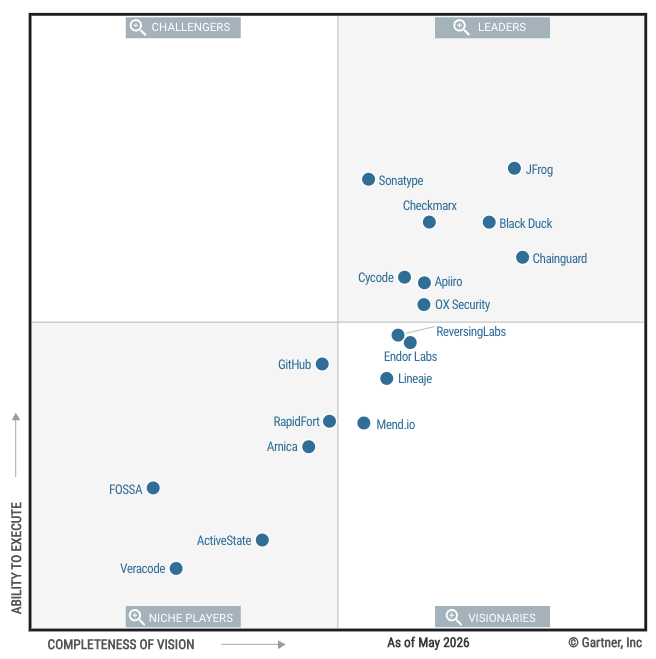
According to the 2026 Gartner® Magic Quadrant™ for Software Supply Chain Security, protecting software now requires a dedicated security discipline focused on securing every third-party component that enters modern software factories, not just open source packages, but also containers, commercial software, AI models, MCP servers, build systems, artifact registries, developer environments, and runtime workloads. Gartner defines Software Supply Chain Security (SSCS) as a stand-alone market designed to reduce business risk from third-party software across the entire software lifecycle.
For security leaders, that's a significant shift.
The Attack Surface Is No Longer Just Source Code
Today's software rarely consists of code written entirely in-house.
A modern application may include:
- Hundreds or thousands of open source dependencies
- Container images
- Commercial software components
- Third-party APIs
- AI models
- Model Context Protocol (MCP) servers
- CI/CD pipelines
- Artifact registries
- Runtime services
Each introduces its own trust relationship.
As Gartner notes, organizations control relatively little about upstream software providers while remaining fully responsible for the software they ultimately deploy. The result is an expanding attack surface that reaches far beyond traditional application security.
The rise of AI-generated code only accelerates this trend.
Development teams are shipping software faster than ever, often consuming more external software than they create themselves. Security teams can no longer rely on periodic scans or vulnerability reports after deployment. They need continuous visibility into what enters the software factory, what actually runs in production, and which risks deserve immediate attention.
Gartner's View of Modern SSCS
One of the most interesting aspects of Gartner's report is how broad the definition of software supply chain security has become.
Mandatory capabilities now include:
- Third-party software risk protection
- Software composition analysis across source, binaries, containers, artifact registries, and runtime
- SBOM generation and lifecycle management
- Continuous threat intelligence
- Third-party reputation analysis
- Governance across commercial software, open source, containers, AI, and software delivery pipelines
Gartner also highlights emerging capabilities that are rapidly becoming important, including:
- Runtime reachability analysis
- Vulnerability exploitability context
- AI supply chain governance
- VEX and CSAF support
- Provenance and attestations
- Secure artifact catalogs
- Automated replacement of compromised artifacts
- Developer workspace security
- AI-assisted remediation workflows
The common thread is clear: organizations need far more context than vulnerability counts alone.
Why Prevention Is Becoming More Important Than Detection
Security teams have become exceptionally good at finding vulnerabilities.
They're much less successful at eliminating them before software reaches production.
Traditional scanning often produces thousands of findings, many of which aren't exploitable, aren't reachable, or won't ever execute. Meanwhile, developers continue shipping software because releases cannot wait for endless triage.
The industry is shifting toward reducing risk before software is deployed.
That means:
- Consuming curated software instead of vulnerable upstream packages
- Using hardened container images
- Understanding software provenance
- Continuously monitoring runtime behavior
- Prioritizing vulnerabilities based on actual execution
This represents a move from vulnerability management toward software risk reduction.
How RapidFort Aligns with This Shift
RapidFort was founded on a simple idea:
The best vulnerability is the one that never reaches production.
Rather than relying solely on scanning after software has already been built, RapidFort helps organizations reduce risk earlier by delivering curated, hardened software artifacts while continuously validating what actually executes in production.
In Gartner's evaluation, RapidFort is recognized for several differentiated capabilities, including:
RapidFort continuously maintains hardened operating system and application images backed by managed package repositories supporting standard Linux distributions including Ubuntu, Red Hat, Alpine, and Debian.
Unlike a traditional SBOM that lists everything included in an artifact, RapidFort Runtime Bill of Materials identifies the software components actually executing within production workloads using runtime instrumentation. This allows organizations to understand real execution behavior rather than theoretical package inventories.
RapidFort has expanded its platform with vulnerability applicability intelligence, artifact hardening generation, artifact lifecycle management, and a curated catalog of hardened images designed to reduce attack surface before deployment.
These capabilities reflect a broader industry trend toward combining build-time security with runtime intelligence.
Runtime Context Changes Everything
One of the biggest challenges in software security is determining which vulnerabilities actually matter.
A package may contain dozens of CVEs.
Only a handful may ever execute.
Some may never even load into memory.
Runtime context helps separate theoretical exposure from operational risk.
This is one reason Gartner highlights runtime analysis and reachability as increasingly important capabilities within the evolving SSCS market.
Knowing what actually runs allows organizations to:
- Prioritize remediation based on execution
- Reduce unnecessary patching
- Focus developers on meaningful fixes
- Eliminate alert fatigue
- Better understand production software behavior
AI Makes Software Supply Chain Security Even More Important
AI coding assistants dramatically increase development velocity.
They also increase software consumption.
Developers can generate code, import new packages, introduce unfamiliar dependencies, and integrate AI services faster than ever before.
The result is an expanding software supply chain that now includes AI models, MCP servers, plugins, extensions, and entirely new categories of third-party software.
Organizations need governance that keeps pace with this acceleration without slowing developers down.
That is why Gartner now includes AI supply chain governance alongside traditional software supply chain capabilities.
The Future Belongs to Software Factories Built on Trust
The software supply chain is no longer a niche concern for application security teams.
It has become foundational infrastructure.
Every package, artifact, image, model, and dependency represents either trusted software, or potential compromise.
Organizations that continue relying solely on vulnerability scanning will struggle to keep pace with AI-driven development and increasingly complex software ecosystems.
The next generation of software supply chain security combines prevention, curated software, runtime intelligence, threat context, governance, and continuous validation.
That is the direction Gartner identifies for the market.
And it's the direction RapidFort has been building toward from the beginning.
The 2026 Gartner® Magic Quadrant™ for Software Supply Chain Security examines how the market is evolving and what capabilities organizations should evaluate when selecting an SSCS platform.
Download the report to learn:
- Why Software Supply Chain Security has emerged as its own security market
- The mandatory capabilities Gartner recommends evaluating
- How runtime context and exploitability are changing vulnerability prioritization
- Why secure artifact catalogs and hardened software are becoming strategic investments
- How vendors are addressing third-party software risk across the modern software factory
Gartner, Magic Quadrant for Software Supply Chain Security, Aaron Lord, Johnny Walters, Jason Gross, 17 June 2026. Gartner does not endorse any vendor, product or service depicted in its research publications and does not advise technology users to select only those vendors with the highest ratings or other designation. Gartner research publications consist of the opinions of Gartner's research organization and should not be construed as statements of fact.




Eliminate Attack Vectors at the Source
Continuously eliminate up to 99.9% of CVEs without code changes


Products
Use Case
Quicklinks
Address
440 North Wolfe Road, Sunnyvale, CA 94085


Stay in touch
Subscribe for product updates and RapidFort newsletter.
© 2026 RapidFort, Inc.
RapidFort, RAPIDFORT, and RBOM® are registered trademarks of RapidFort, Inc. All other marks and names mentioned herein may be trademarks of their respective companies.