
The only scalable solution is to eliminate attack vectors before they reach production. RapidFort does this continuously, across every framework, without code changes.


Between 2016 and 2025, 235,000 CVEs had fixes identified — but each fix must be individually integrated, backported, peer-verified, and regression tested. Approximately 85% of enterprise software is open source. Technical security debt mounts.
Attackers leverage AI to move faster — disclosure-to-exploit windows are now less than 10 hours, down from 24 months ten years ago. Point-in-time scans cannot satisfy continuous monitoring for ATO, FedRAMP, CMMC, DORA, or NIS2.
Without continuous protection, the software supply chain becomes the path of least resistance. Security teams are overwhelmed by alerts, false positives, and compliance obligations. Traditional tools are fragmented and require manual action.
Most base images lack FIPS 140-2/3 validated cryptographic modules. This single gap blocks DoD authorization in the US and creates barriers to eIDAS and CRA compliance across European public sector environments.
Security is not a checkpoint. It is a continuous system embedded into how software is delivered.

SBOM generation per image and per build
Intelligent CVE identification across packages, files, and OS layers
~25% scanner noise reduction via CVE applicability validation
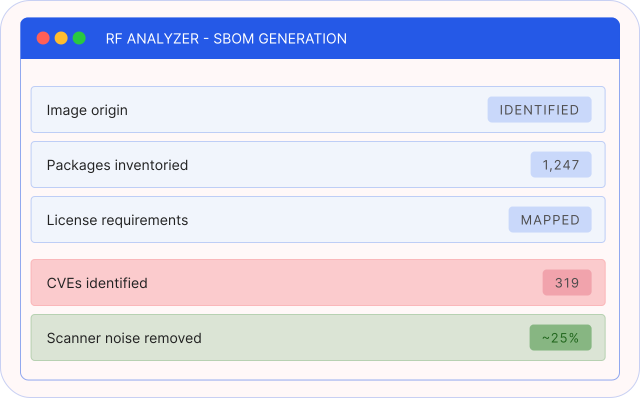
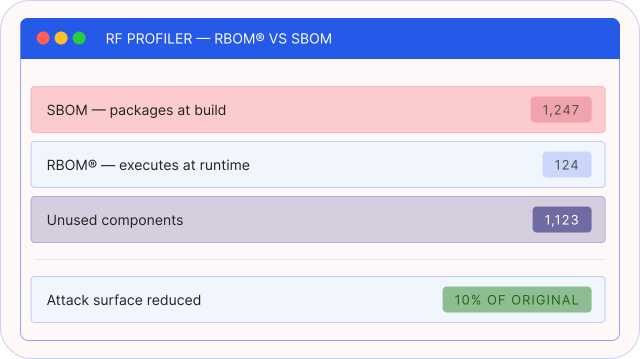
RBOM® generation — Runtime Bill of Materials (USPTO registered)
Removes unused packages, libraries, and binaries
Up to 90% attack surface reduction without code changes
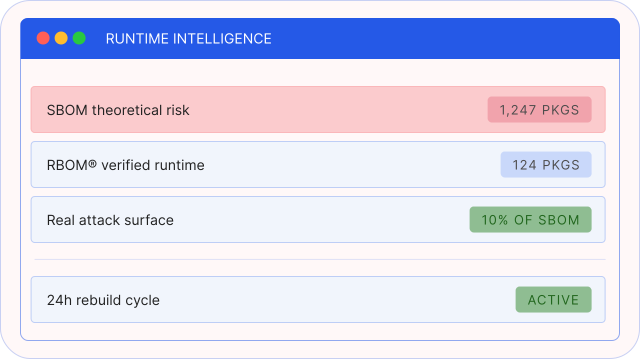
Continuous runtime monitoring and threat detection
RBOM® separates true attack surface from theoretical SBOM risk
24-hour continuous optimization cycles
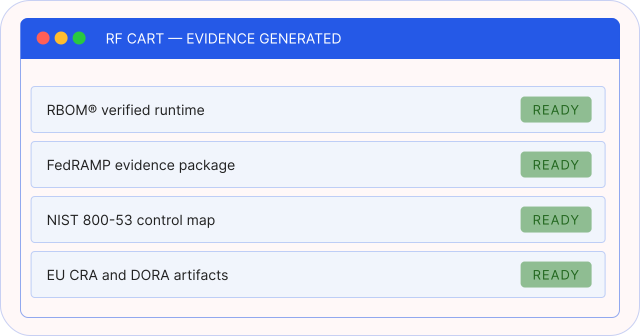
Automated STIG, CIS, NIST 800-53 evidence generation
FedRAMP, ATO, and CMMC 2.0 audit artifact compilation
Maps to EU CRA, DORA, and NIS2 technical security measures
Start with a high-impact problem. Prove value quickly. Expand across the environment.
RapidFort CART compiles security benchmarks into audit-ready documents for ATO, NIST, FedRAMP, and other standards.
Five paths designed for how organizations actually adopt security starting with a high-impact problem, proving value quickly, and expanding across the environment.

Less manual remediation

Hardening cycle

CVE reduction

Attack surface reduction

Code changes required

Cryptographic variants
Five paths designed for how organizations actually adopt security starting with a high-impact problem, proving value quickly, and expanding across the environment.


Instead of chasing vulnerabilities, organizations eliminate them at scale.
Gartner Magic Quadrant · Gartner Cool Vendor 2025 Nutanix .Next Partner of the Year 2026


