Automated Vulnerability Remediation

Remediate CVEs Automatically - Without Changing Your Code.

Traditional scanners only tell you what’s wrong. RapidFort closes the gap between detection and remediation by eliminating inherited vulnerabilities, removing unused components, and producing runtime-verified RBOM™ evidence that proves what is truly safe to deploy.

Integrates with any scanner, registry, or CI/CD pipeline
Eliminates upstream CVEs with curated image swap guidance
Reduces attack surface by removing unused software

Why Vulnerability Backlogs Keep Growing Faster Than Teams Can Remediate Them

Modern development velocity, expanding dependency chains, and rising compliance pressure have made traditional remediation workflows unsustainable. The issue is no longer detection - it’s the inability to fix vulnerabilities quickly, accurately, and with defensible proof.

Endless Alerts Without Actionable Insight

Scanners generate thousands of findings, yet provide no clarity on which vulnerabilities are exploitable or even applicable - leaving security teams buried in noise.

Vulnerabilities Inherited Before Development Begins

Public and vendor base images carry large CVE backlogs, embedding security debt into every service from day one

Patch Cycles That Slow Down Delivery

Rebuilding, validating, and retesting containers across microservices consumes weeks, creating release bottlenecks and mounting backlogs.

Growing Demands for Evidence-Backed Remediation

Regulators and enterprise buyers expect runtime-linked, auditable proof of security - not screenshots or static scan outputs.

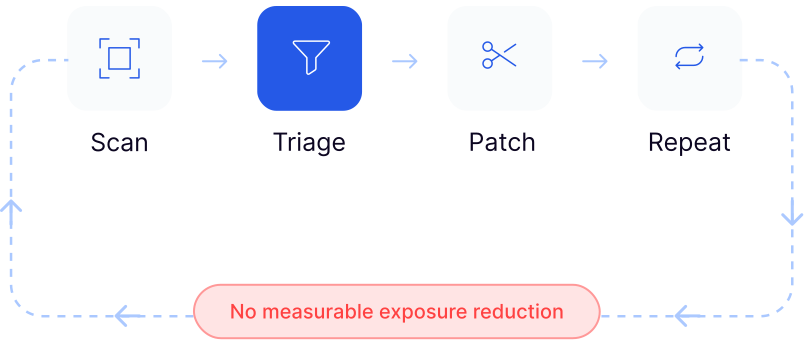
The Manual Patch Cycle Cannot Scale

1

Scan

Detection volume grows exponentially, outpacing triage capacity.

2

Triage

False positives, duplicate findings, and lack of runtime context drain engineering bandwidth.

3

Patch & Rebuild

Every update requires editing Dockerfiles, rebuilding services, retesting functionality, and redeploying - across every environment.

Conclusion :

Modern software environments require remediation that is automated, runtime-aware, and built on secure foundations - not more manual cycles.

The New Standard for Vulnerability Remediation

Remediation Driven by Runtime Truth

Fix only what is exploitable, reachable, and actually executed - supported by execution-path intelligence and binary validation.

Zero Inherited Vulnerability Debt

Start on hardened, continuously rebuilt curated images aligned to NIST, STIG, and CIS benchmarks - not vulnerable public images.

Evidence That Withstands Audit Review

Deliver hardened outputs with SBOM, RBOM™, CIS/STIG evidence, and justification trails tied to real runtime behavior.

Automated Remediation in Three Steps

Profile

RapidFort performs deep vulnerability analysis and runtime profiling to determine what matters. This includes complete SBOM/RBOM generation, CVE applicability validation, prioritization based on execution paths, and CIS/STIG configuration checks to ensure accurate, context-driven remediation.

Outcome

A precise, prioritized remediation plan grounded in runtime reality.

Curated Images

RapidFort provides 17,000+ Near-Zero CVE Images hardened with STIG/CIS benchmarks and aligned to NIST SP 800-70. Analyzer also identifies when upstream images should be replaced and recommends curated equivalents that eliminate inherited vulnerabilities immediately.

Outcome

A secure, compliant foundation that removes upstream risk before remediation begins.

Optimize & Harden

RapidFort automatically removes unused binaries, libraries, and OS components without modifying application logic - significantly reducing vulnerability exposure and improving performance.

Outcome

Up to 95% CVE reduction and 90% attack-surface reduction in minutes.

Security and Productivity Gains That Scale Across the Organization

↓ up to 95%

CVE Backlog Reduction

↓ up to 90%

Attack Surface Reduction

↓ ~60%

Manual Remediation Effort

FedRAMP, CMMC, SOC 2


Compliance Preparation Time

Stop Trying to Patch Your Way Out of CVE Backlogs. Start Eliminating Them Automatically.

Transform detection into verified remediation - without rewriting your application, refactoring Dockerfiles, or slowing development.