
Container Escape Techniques: What Defenders Need to Know

Vice President of Business Development
After reading this guide
At a Glance
- A container escape is any path that lets a process inside a container reach the host kernel, host filesystem, or other tenants.
- The most common root causes are kernel vulnerabilities, privileged or misconfigured containers, exposed Docker or Kubernetes sockets, writable host path mounts, and dangerous Linux capabilities.
- Defense starts with least privilege: drop capabilities, use a read-only root filesystem, and avoid the privileged flag entirely.
- Runtime detection with eBPF-based tools such as Falco and policy engines like OPA/Gatekeeper catches escapes as they happen.
- Hardened runtimes such as gVisor and Kata Containers add an isolation boundary that blunts kernel-exploit escape attempts.
- NIST SP 800-190 and the CIS Benchmarks are the baseline references every defender should map controls to.
Container escape techniques are the methods attackers use to break out of an isolated container and reach the host or other workloads. They range from kernel exploit chains and misconfigured privileges to exposed container sockets, dangerous host path mounts, and overly broad Linux capabilities. Knowing the catalog is the first step to defending against it.
What Is a Container Escape and Why Does It Matter?
A container is not a security boundary by itself. It is a set of kernel namespaces and cgroups that give the illusion of isolation. The kernel is shared with every other container and the host. An escape happens the moment a process inside a container breaks that illusion and gains access it was not supposed to have: host files, other containers, the kubelet, or the node itself.
In a multi-tenant cluster or a shared CI runner, a single escape can mean full node compromise and, from there, lateral movement across the cluster. That is why container escape sits at the top of most threat models for Kubernetes and container platforms.
Common escape classes at a glance:
| Escape class | What it abuses | Typical impact |
|---|---|---|
| Kernel exploit | Unpatched kernel CVE | Root on host |
| Privileged container | Full device and namespace access | Immediate host control |
| Exposed socket | Docker or K8s API on the mount | Workload creation, host exec |
| Host path mount | Writable host dir such as /etc | Persistence, credential theft |
| Risky capability | CAP_SYS_ADMIN and similar | Namespace breakout |
Which Kernel Exploits Enable Container Escape?
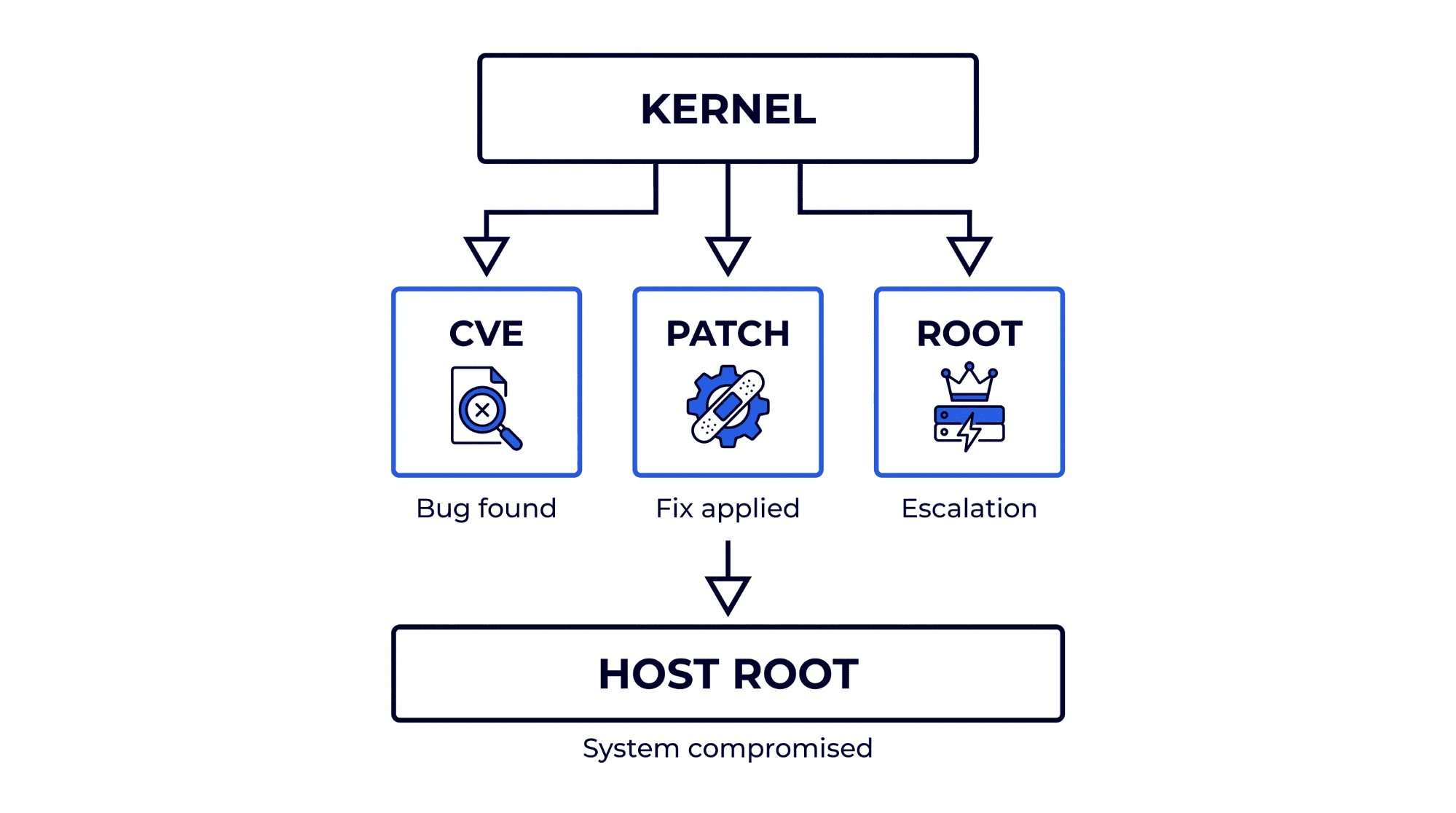
Containers share the host kernel, so any kernel vulnerability that yields privilege escalation can become an escape. Historically, dirty-pipe-style flaws and other local privilege escalation bugs have been used to overwrite host files from inside a container. The exploit chain is usually: gain code execution in the container, trigger the kernel bug, and use the resulting root to remount the host filesystem via /proc or the container's own namespace.
The mitigating factor is that these bugs require a vulnerable, unpatched kernel. That points straight at patch hygiene and minimal attack surface:
- Track kernel CVEs and prioritize by EPSS score and CISA KEV inclusion, not just CVSS. Alternatively, you can prioritize CVEs by using the BOD 26-04 directive.
- Keep node images small and current; fewer packages means fewer kernel-adjacent attack paths. Use curated base images and consider optimizing/hardening your applications.
- Use a hardened runtime (gVisor, Kata) that intercepts syscalls so a kernel bug in the guest does not become a host bug.
How Do Misconfigured Privileges Lead to Escape?
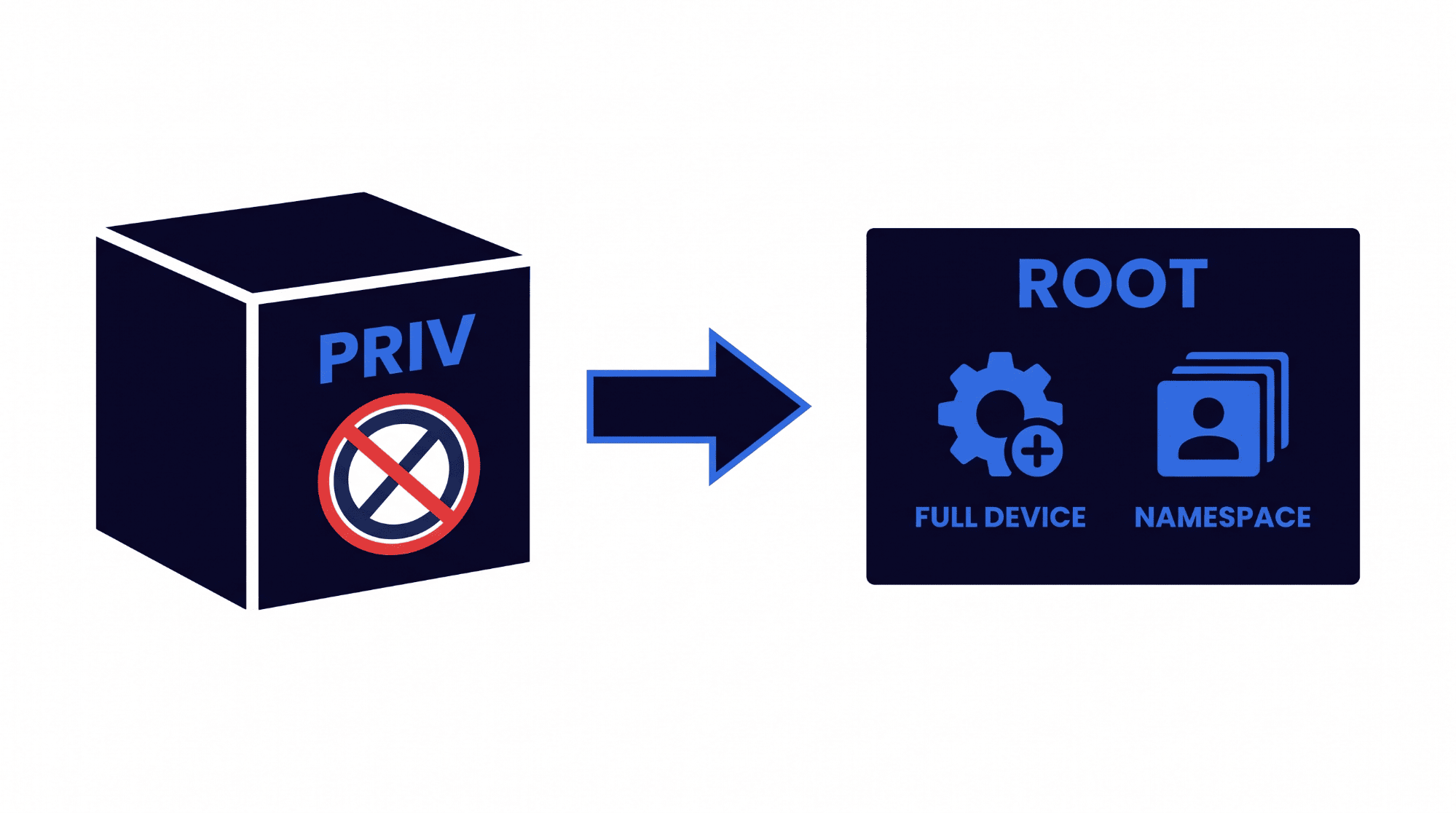
The privileged: true flag in Kubernetes disables nearly every
isolation control. It gives the container all Linux capabilities, access
to all devices, and the ability to escape its own namespaces. Running a
workload privileged is effectively running it as root on the host.
Even short of full privilege, these settings are dangerous:
-
hostPID: trueandhostIPC: trueexpose host process and IPC namespaces. hostNetwork: trueputs the pod on the host network.- Running as UID 0 with no
runAsNonRootcheck.
Mitigation is mostly Pod Security Standards. Enforce the
restricted profile via OPA/Gatekeeper or Kyverno, and fail
closed on admission. A hardened image supply chain (SBOM with Syft or
RapidFort Analyzer, scanning with Trivy or Grype or RapidFort Analyzer)
reduces the chance that an attacker ever gets execution inside the
container in the first place.
Why Are Exposed Container Sockets a Risk?
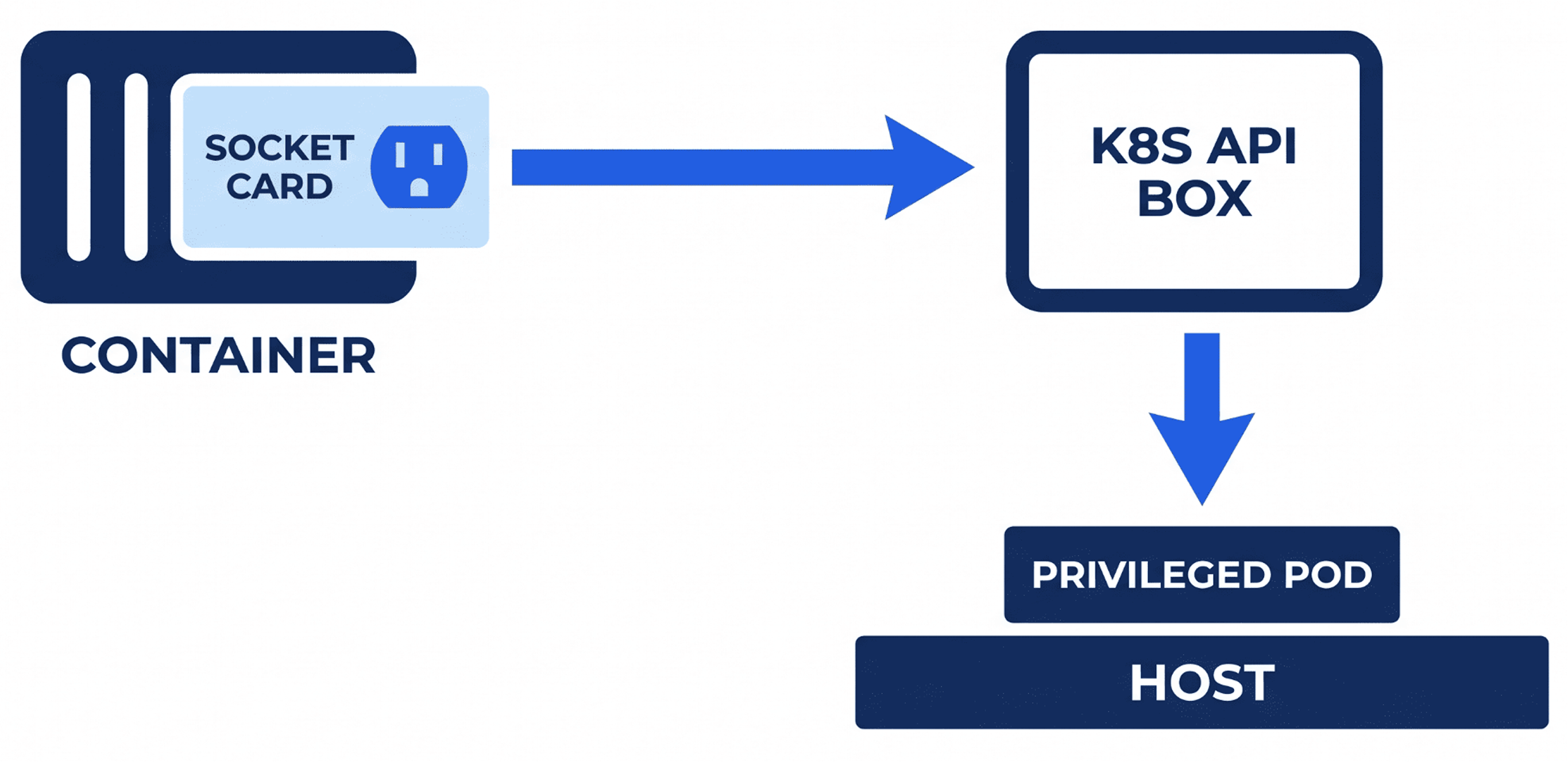
If a container can reach the Docker socket (/var/run/docker.sock)
or the Kubernetes API server with a service account that can create pods,
escape is trivial: instruct the API to launch a privileged pod mounted to
the host, then exec into it. This is one of the most common real-world
escapes because it shows up in CI tooling and debug sidecars.
Defenses:
- Never mount the Docker socket into a container unless the container's whole job is to be the node agent, and even then scope it tightly.
-
Use
automountServiceAccountToken: falsefor workloads that do not need the API. - Restrict kubelet and API permissions with RBAC least privilege; a pod should not be able to create host-path-mounted privileged pods.
How Do Mounted Host Paths Create Escape Paths?
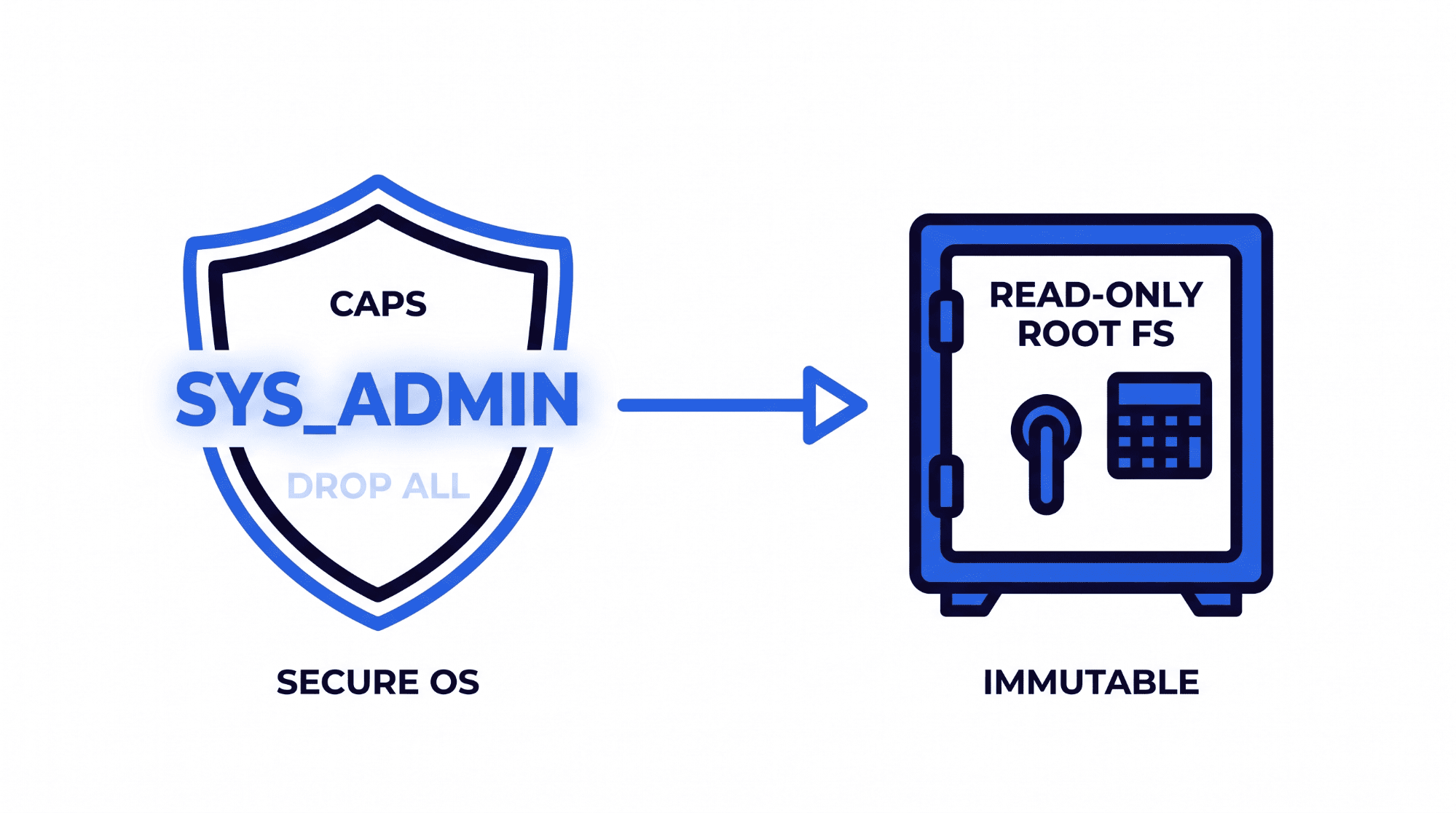
Mounting a host directory into a container is convenient and dangerous. A
writable mount of /, /etc,
/var/lib/kubelet, or the host's /proc lets a
container write host configuration, drop an SSH key, or hijack a systemd
unit for persistence. Even read-only mounts can leak secrets.
The escape table for mounts:
| Host path | Risk if writable | Defense |
|---|---|---|
| /var/run/docker.sock | Full node control | Do not mount |
| /etc | Add persistence, credentials | Mount read-only, specific file |
| / | Total host compromise | Never mount |
| /proc | Namespace escape primitives | Drop CAP_SYS_ADMIN |
| /var/lib/kubelet | Node workload tampering | Restrict RBAC and filesystem |
Which Linux Capabilities Are Risky?
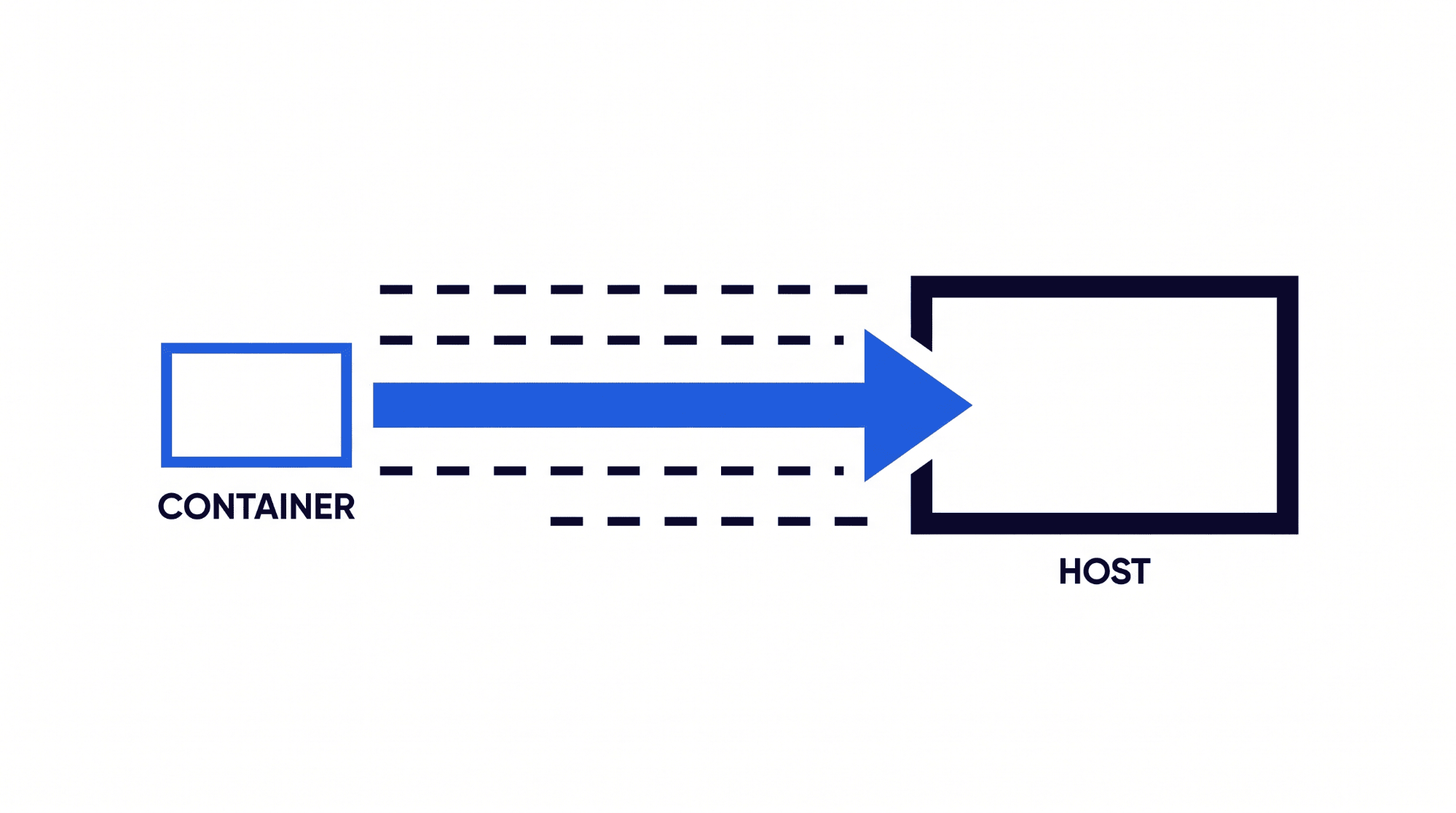
Linux capabilities split root's power into granular pieces, but several
are escape-equivalent. The big one is CAP_SYS_ADMIN, which is
close to full root and enables mounting, namespace creation, and other
breakout primitives. Others include CAP_SYS_PTRACE (inspect
or modify other processes), CAP_NET_ADMIN (network
manipulation), and CAP_DAC_READ_SEARCH (read any file).
The baseline is to drop all capabilities and add back only what the workload needs:
-
Kubernetes containers start with a default set of capabilities unless
you set
capabilities.drop: ["ALL"]. -
Use
securityContext.capabilities.drop: ["ALL"]andaddonly the specific caps required. -
Pair this with
readOnlyRootFilesystem: trueandallowPrivilegeEscalation: false.
How Can You Detect and Prevent Container Escapes?
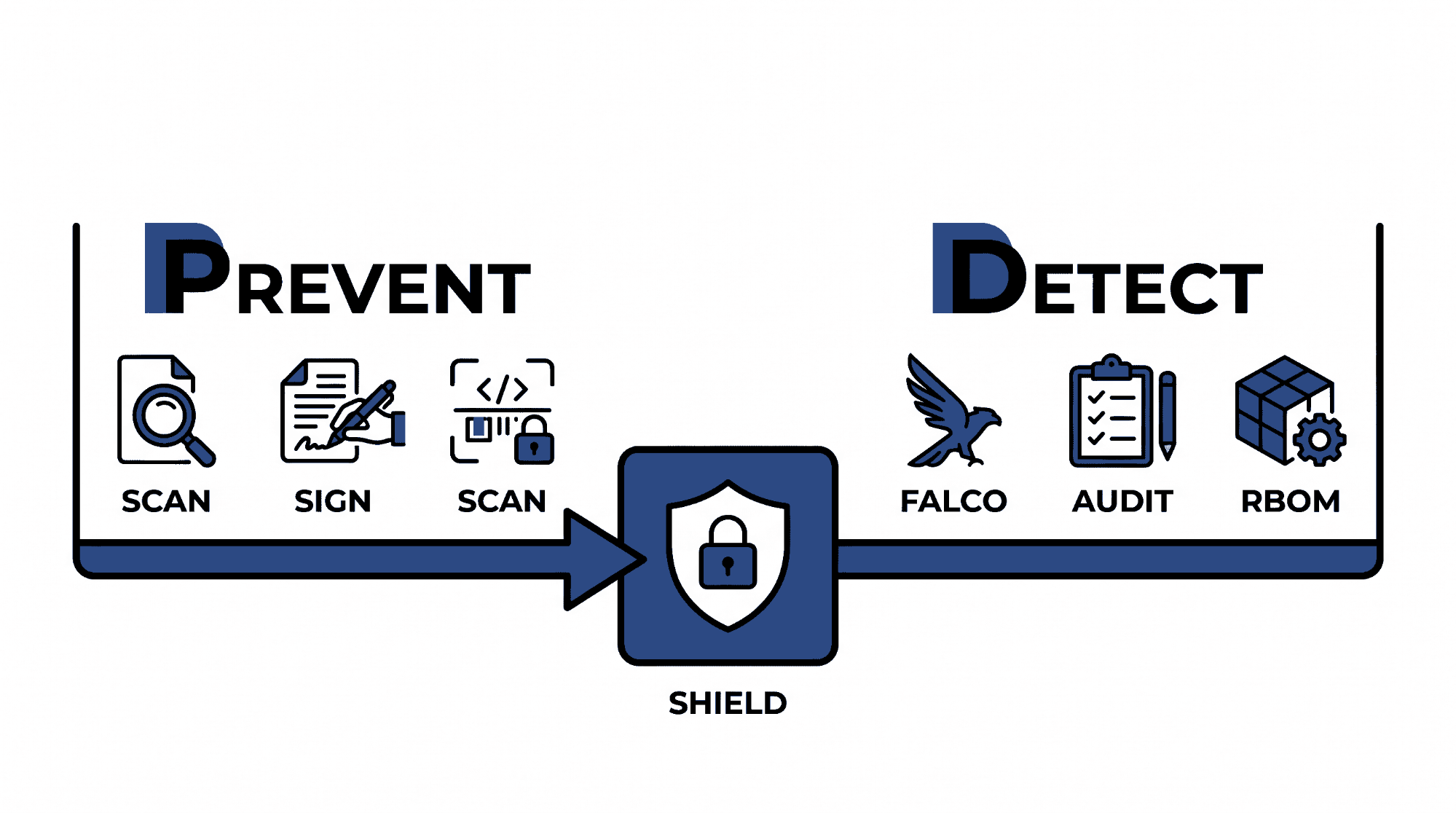
Detection and prevention work together. Prevention narrows the surface; detection catches the attempts that get through.
Prevention checklist:
-
Run as non-root; set
runAsNonRoot: trueand a non-zerorunAsUser. - Drop all capabilities, read-only root FS, no privileged flag, no host namespaces.
- Scan images in CI and block high-severity CVEs before deploy (Trivy, Grype, RapidFort Analyzer).
- Admit only signed images via Sigstore/cosign and verify with an admission policy.
- Enforce with Kyverno or OPA/Gatekeeper mapped to NIST SP 800-190 and CIS Benchmarks.
Runtime detection:
-
Deploy Falco (eBPF) to alert on suspicious syscalls: a shell in a
container touching
/host, unexpected mounts, or a process reading the Docker socket. - Centralize audit logs from the kube-apiserver and kubelet; watch for pod create with hostPath.
- Use RapidFort Profiler to build a runtime RBOM® and baseline normal behavior, then flag deviations that signal an escape attempt. Optionally, optimize your application to reduce the attack surface.
A hardened runtime such as gVisor or Kata Containers adds a kernel-level boundary: even a successful in-container kernel exploit cannot reach the host kernel, which neutralizes the entire kernel-exploit escape class. For images themselves, RapidFort Curated Images provide tens of thousands of curated, near-zero-CVE images that reduce the exploitable surface before a container ever runs.
Container Escape Techniques FAQ
What is the difference between a container escape and privilege escalation?
Privilege escalation is gaining higher rights inside the same security context (for example, user to root within the container). A container escape specifically crosses the container boundary to reach the host, other containers, or the node. An escape often starts with in-container privilege escalation, then breaks isolation.
Can a non-privileged container still escape?
Yes. A non-privileged container with a writable host path mount, the Docker socket, or a missing capability drop plus a kernel exploit can still escape. Privilege is not the only path; configuration and mounted resources matter just as much.
Which tool detects container escapes at runtime?
Falco is the most widely used open-source runtime detector; it uses eBPF to watch syscalls and fires rules on escape indicators like host filesystem access from a container. Falco alerts can feed SIEM or incident response workflows for fast containment.
How does NIST SP 800-190 help prevent escapes?
NIST SP 800-190, the Application Container Security Guide, lays out container-specific hardening: image trust, orchestrator configuration, and runtime controls. Mapping your Pod Security Standards, RBAC, and admission policies to its recommendations closes the most common escape gaps.
Are gVisor and Kata Containers worth the overhead?
For multi-tenant or untrusted workloads, yes. They add a sandbox or separate kernel that contains kernel-exploit escapes. The cost is some performance and compatibility overhead, so teams typically apply them to the highest-risk tenants rather than every pod.
Key takeaways
- A container escape is any path that breaks the kernel-namespace isolation and reaches the host, other containers, or the node.
- The main techniques are kernel exploits, privileged or misconfigured containers, exposed Docker or Kubernetes sockets, writable host path mounts, and dangerous capabilities such as CAP_SYS_ADMIN.
- Prevention is least privilege: drop all capabilities, no privileged flag, run non-root, read-only FS, and enforce with Kyverno or OPA/Gatekeeper.
- Runtime detection with Falco (eBPF) plus audit-log monitoring catches escape attempts that slip past prevention.
- Hardened runtimes (gVisor, Kata) and a minimal, scanned, near-zero-CVE image supply chain remove whole classes of escape.
- Map controls to NIST SP 800-190 and the CIS Benchmarks to keep the escape surface measurable and auditable.


