
How a new generation of AI vulnerability discovery tools, including models like Claude Mythos, is reshaping enterprise security and what your container teams must do now.
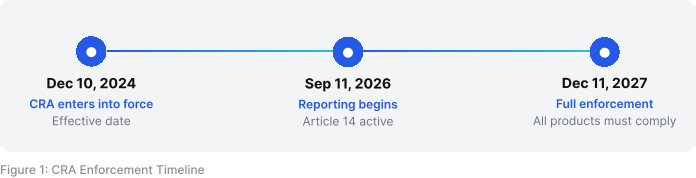
Full CRA enforcement for all products in EU markets
Reporting obligations begin under Article 14
CSIRT and ENISA early warning for active exploits
01
Introduction
02
What the CRA Covers in Cloud-Native Environments
03
The Mythos Era: AI and the New Vulnerability Threat
04
Three CRA Requirements Every Container Team Must Know
05
How the CRA Affects Your Kubernetes Cluster
06
How to Prepare: Four Practical Steps
07
How RapidFort Helps You Meet CRA Requirements
Written for security and engineering leaders, including CISOs, DevSecOps teams, platform engineers, and compliance officers responsible for cloud-native workloads distributed to EU markets.
Regulation
EU Cyber Resilience Act (Regulation (EU) 2024/2847)
In Force
December 10, 2024
Reporting Begins
September 11, 2026
Full Enforcement
December 11, 2027
Scope
Container images, Kubernetes operators, and Helm charts distributed commercially to EU markets
Key Obligations
Security by design, ongoing vulnerability management with SBOM documentation, five-year minimum support period
Reporting Windows
24-hour and 72-hour notifications to the CSIRT coordinator and ENISA; 14-day final report once corrective or mitigating action is available
Vulnerability Elimination
Achievable in hours, not months
Attack Surface Reduction
Without code changes
Top AI Companies
Across customer deployments
01
The EU Cyber Resilience Act (CRA) sets mandatory cybersecurity standards for every product with digital elements sold in EU markets. It came into force on December 10, 2024, with incident reporting obligations starting September 11, 2026, and full enforcement from December 11, 2027.
For container and cloud-native teams, the CRA is not a distant concern. It shapes how cloud-native applications are built, distributed, and maintained. This guide explains what compliance requires and how AI tools like Mythos make urgency unavoidable.
02
Commercially supplied container images, Kubernetes operators, Helm charts, and other software components may fall within the CRA when they qualify as products with digital elements or integrated components made available on the EU market.
Open-source software is only in scope when distributed commercially. Non-commercial open-source projects are exempt, though organisations that systematically monetise such projects may carry obligations as software stewards under Article 24.
Within CRA Scope
Key Nuances
Container Images
Commercially distributed to EU markets
Product Reach
Where your users are, not where you are based
Kubernetes Operators
Sold or licensed as a commercial product
EU Customer Access
Having EU users triggers CRA compliance
Helm Charts
With paid support agreements or SLAs
Supply Chain
Vendor obligations pass through to you
Open Source Software
When embedded in a commercial product
Commercial Terms
Paid SLAs and support raise your duties
Figure 2: CRA Scope and Application Nuances
03
Anthropic reports that Claude Mythos Preview has demonstrated advanced vulnerability-discovery capabilities across major operating systems, browsers, and open-source projects; treat this as an emerging but credible signal that timelines are compressing, as independent validation of its full scope remains limited.
If such capabilities scale as described, discovery could span a broader surface and map how individual flaws chain into exploit paths, meaning a list of CVEs may represent compounding rather than linear risk.
Discovery Is Scaling
AI systems surface security flaws faster and across far broader code bases than human researchers, at a pace no traditional patch cycle was designed to match.
Remediation Is Not
Patching, validation, and deployment still run at human speed. The gap between known vulnerabilities and fixed ones grows wider every day.
Base images, system libraries, and open-source dependencies inside Kubernetes clusters are exactly the kind of long-lived, widely-deployed code that AI discovery tools target first. Vulnerabilities quiet in production for years are now being found faster than any patch process was designed to handle.
The CRA's 24-hour reporting window to the CSIRT coordinator and ENISA, continuous SBOM obligations, and five-year support requirements were designed precisely for this gap between discovery and remediation. Reacting to vulnerabilities as they surface is no longer a defensible posture. Reducing the software attack surface is the only answer.
Anthropic reports that Claude Mythos Preview is compressing vulnerability-discovery timelines while enterprise patching still lags at 30 to 45 days, though independent validation of these capabilities remains limited. RapidFort's Mythos Readiness Assessment gives you a clear, prioritised view of your true exposure with no code changes required and actionable results within minutes.
04
The CRA introduces three categories of obligations that directly affect how container infrastructure is built, monitored, and maintained.
01
Security by Design
Hardened base images, minimal software attack surface, and secure defaults as legal requirements, not recommendations.
02
Vuln. Management
SBOM documentation, continuous monitoring, and 24-hour reporting to the CSIRT coordinator and ENISA for actively exploited vulnerabilities.
03
Long-Term Security
Security updates, rebuild pipelines, and backward-compatible patching for a minimum of five years from first release.
The CRA requires base images to be hardened, with unnecessary components removed and secure configurations applied, before products reach the market. What the cloud-native community has long recommended as best practice is now a legal obligation.
Under Article 14, your team must maintain an SBOM, monitor continuously for vulnerabilities, and meet strict notification timelines when actively exploited vulnerabilities are discovered:
Initial notice to the CSIRT coordinator and ENISA via the single reporting platform
Detailed product, exploit, and mitigation information
Final report after a corrective or mitigating measure is available; severe incidents carry a separate one-month timeline
The CRA requires security update support for the full life of your product, at minimum five years from first release. This means tracking which container versions your customers run, keeping rebuild pipelines active for older images, and ensuring fixes can be applied without breaking compatibility.
05
A typical Kubernetes production deployment pulls container images from many sources, each with its own security practices and update cadence. Where those components qualify as products with digital elements made available on the EU market, CRA obligations may apply.
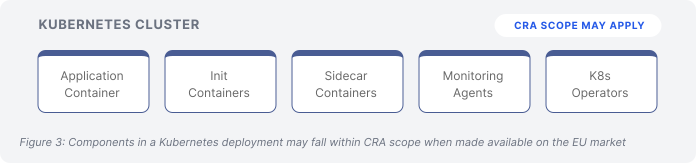
If your product integrates third-party operators, controllers, or images, you may have due-diligence and vulnerability-management obligations for the integrated product. The supplier's own CRA obligations remain separate.
06
These four areas give any cloud-native team a practical starting point for CRA readiness.
01
Start from secure, hardened base images with no inherited vulnerabilities. Remove unnecessary software to reduce the software attack surface before reaching production.
02
Add runtime profiling to distinguish what is installed from what actually executes. RapidFort's RBOM® can complement your SBOM by showing which components are reachable at runtime, helping prioritise remediation and document risk-based vulnerability handling.
03
Know how security updates flow to your users. Ensure registry policies enforce consistent standards across all environments and customer deployments.
04
Understand who maintains the images you depend on and how quickly they respond to security issues. Know whether their cadence meets your CRA obligations.
The CRA shifts software security from best practice to enforceable product requirement. With AI tools like Mythos accelerating discovery, the window for reactive remediation is closing. Here is what matters most for your teams.
A minimal software attack surface and secure defaults are now legal obligations. Non-compliance carries regulatory consequences, not just reputational risk.
Pair static SBOM generation with runtime evidence of what actually executes in production. RapidFort's RBOM® complements the SBOM by helping prioritise remediation and document risk-based vulnerability handling.
Detection and incident response must work at scale across your clusters. If you cannot notify the CSIRT coordinator and ENISA within 24 hours of an actively exploited vulnerability, you are not meeting your Article 14 obligations.
Every container version distributed to customers needs a rebuild pipeline, a security update pathway, and backward compatibility planning from day one.
In the age of AI-accelerated discovery, patching cannot keep pace. Eliminating unused code and hardening images at source is the only sustainable approach.
RapidFort is a software supply chain security platform that helps enterprises eliminate vulnerabilities at the source. Founded in 2020 and headquartered in Silicon Valley, RapidFort serves over 100 enterprise and public-sector customers, including 7 of the top 10 AI companies, with curated near-zero CVE base images, runtime profiling, and end-to-end software attack surface management. Recognised as a Gartner Cool Vendor in Container Management.
07
RapidFort eliminates vulnerabilities at the source, delivering curated near-zero CVE base images, automated SBOM generation, and RapidFort's RBOM® as a runtime prioritisation layer, achieving up to 99.9% vulnerability reduction with 90% software attack surface reduction, all without code changes.
CRA Requirement
How RapidFort Addresses It
Secure by design and by default
Curated near-zero CVE base images, hardened and continuously patched
SBOM documentation for all components
Automated SBOM generation with up to 25% vulnerability noise reduction
Limit attack surfaces and interfaces
Automated removal of unused code, eliminating up to 99.9% of vulnerabilities
Ongoing vulnerability management 5+ yrs
Audit-ready reports, continuous baseline validation, and evidence trail
Table 1: CRA Requirements Mapped to RapidFort Capabilities
Up to 99.9% of vulnerabilities eliminated automatically
Near-zero CVE, manually patched and continuously scanned
Up to 25% noise reduction; RBOM® adds runtime prioritisation
Continuous baseline validation and evidence trail

If your organisation is preparing for CRA compliance and wants to understand how RapidFort can help eliminate vulnerabilities, meet EU regulatory requirements, and stay ahead of AI-accelerated threats like Mythos, speak with our team.
© 2026 RapidFort, Inc.


