

I've been spending a lot of time lately thinking about something that doesn't get discussed honestly enough in security circles: what actually happens when vulnerability discovery scales faster than our ability to deal with it.
Mythos is forcing that conversation.
The Human Ceiling on CVE Discovery
Up until now, CVE discovery has been constrained by human effort. Even very strong researchers top out at a few dozen meaningful findings per year. Large programs might collectively produce a few hundred. Across the entire ecosystem, we land somewhere in the 25–30k CVEs per year range globally. That number has always felt big, but it has also been implicitly bounded by how much human attention exists.
What Mythos changes is not just speed, but surface area. It doesn't get tired. It doesn't get bored walking edge cases. It doesn't stop at the first bug. More importantly, it doesn't think in single vulnerabilities; it thinks in paths.
Run the Numbers: They Get Uncomfortable Fast
If you take a step back and run even a simple model, the implications get uncomfortable pretty quickly.
Let's assume a modest Glasswing-style setup: 25 contributors, each historically capable of finding approximately 30 legitimate vulnerabilities per year. That's 750 vulnerabilities annually in a purely human model. Now layer in AI assistance. Even if you're conservative and assume a 5x productivity gain, which honestly feels restrained given what we're already seeing, you're now looking at 25 × 30 × 5 = 3,750 vulnerabilities discovered per year.
Push the assumptions slightly (say 50 contributors, slightly higher baseline productivity, and closer to a 10x multiplier) and you start brushing up against five-figure annual discovery numbers. That's not a rounding error against the global CVE pool. That's a material shift in the total volume of known vulnerabilities.
But here's where the narrative usually goes off the rails.
People assume that more discovery leads to more security. That's not what happens.
The System Is Bottlenecked. Just Not Where You Think
The system is not bottlenecked at discovery. It's bottlenecked everywhere else.
A vulnerability doesn't become a CVE immediately. It has to be validated, reported, triaged, accepted, patched, released, and then actually deployed into real environments. Even in best-case scenarios, upstream projects take days just to publish fixes. Downstream, organizations take weeks or months to roll them out. We've all seen the Log4j curve: ten days in, less than half the internet was patched.
So if discovery scales from 750 to 3,750 annually, fixes don't follow that curve. They lag. They always lag.
In practice, you end up with something like this: maybe 60% of discovered issues are CVE-worthy, and maybe 70% of those eventually get fixed upstream in a reasonable timeframe. That takes our earlier 3,750 discoveries down to roughly 2,200 CVEs and maybe 1,500 actual fixes that make it into the ecosystem in a meaningful way.
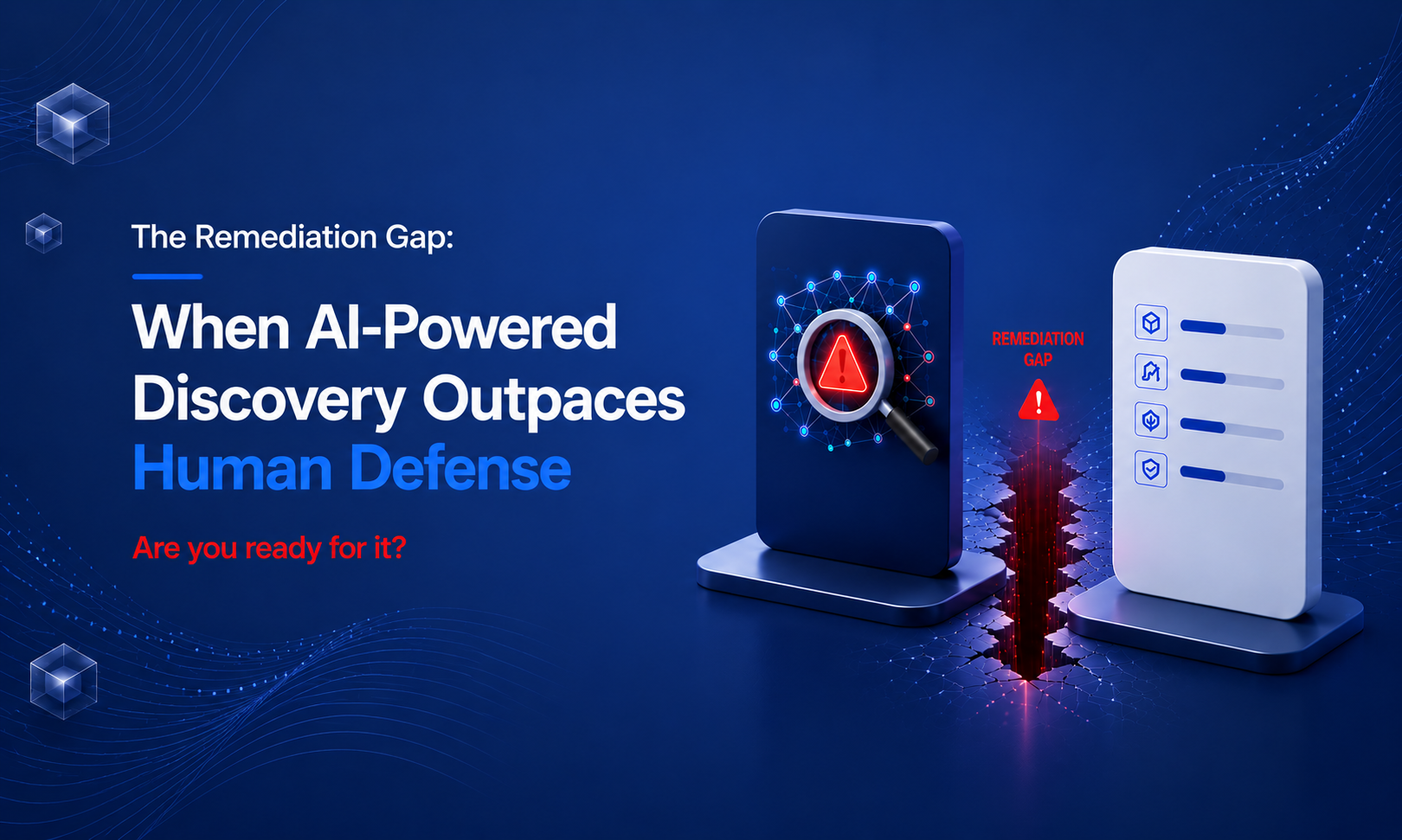
That gap, the difference between what is known and what is remediated, is where the real risk lives. And Mythos widens that gap.
Chained Vulnerability Discovery: A Different Category of Threat
The other shift that matters, and one I think is still underappreciated, is chained vulnerability discovery. Humans are good at finding individual bugs. We are much worse at systematically identifying how those bugs compose into multi-step exploit paths. A typical human-discovered chain might involve two or three vulnerabilities, and even those are relatively rare. If you look across public disclosures, you might see dozens of meaningful multi-step chains identified in a year, maybe stretching into low hundreds if you include more speculative research.
Mythos operates differently. It doesn't stop at "this is a buffer overflow." It asks "what does this enable next?" and then keeps going. We're already seeing exploit paths with 10 or more steps, sometimes far more. That's not just an incremental improvement; it's a different category of capability.
If you think about the combinatorics, the number of possible chains grows exponentially with the number of individual vulnerabilities. When discovery scales, chain discovery doesn't scale linearly; it explodes. A pool of a few thousand vulnerabilities doesn't just represent a few thousand risks; it represents potentially millions of viable paths through a system, most of which will never be explicitly enumerated by humans.
A pool of a few thousand vulnerabilities doesn't just represent a few thousand risks; it represents potentially millions of viable paths through a system.
That has two immediate consequences.
First, severity distribution becomes more dynamic. Today we bucket CVEs into critical, high, medium, and low, and we treat those labels as relatively stable. In practice, most vulnerabilities fall into medium and low categories, with a small percentage classified as critical. But chaining changes that. A "medium" vulnerability that participates in a viable exploit chain can effectively become critical in context. Mythos doesn't care about CVSS scores; it cares about outcomes.
Second, exploitation becomes more automated. The same system that discovers chains can operationalize them. The traditional model, where attackers manually develop and weaponize exploits, starts to collapse. Discovery, chaining, and exploitation compress into a single continuous process.
So we end up in a world where discovery is accelerating, chaining is amplifying impact, and exploitation is becoming more automated, while fixes are still moving at human speed.
That's not a comfortable place to be.
What Actually Works in This Environment
Which brings us to the question I keep coming back to: what actually works in that environment?
If your model is still "find and patch," you are playing a losing game. The math doesn't work. You cannot triage, prioritize, and remediate your way out of a system where vulnerability discovery is scaling superlinearly and exploit development is being automated.
The only viable path is to reduce the problem space itself.
This is where approaches like RapidFort start to make more sense, not less. If you can eliminate up to 99.9% of vulnerabilities with curated and hardened images, you are not just reducing your attack surface; you are collapsing the number of possible exploit paths. If you can start from curated images that already remove the vast majority of known vulnerabilities, you are effectively inheriting fixes for a huge portion of the CVE landscape without having to chase them individually.
More importantly, if that system is continuously tracking new CVE disclosures and pulling in fixes as they become available, you are no longer trying to manually keep pace with discovery. You're letting the system absorb that change automatically, while your exposure remains constrained by design.
That doesn't make the problem go away. New vulnerabilities will still be discovered. Chains will still exist. But the difference between defending a system with 1,000 potential entry points versus 100 is not incremental; it's existential when you consider how these chains form.
The Internet Is About to Get More Secure and Less Secure at the Same Time
Mythos is going to make the Internet both more secure and less secure at the same time. More secure because we will know about far more vulnerabilities, far earlier. Less secure because knowing is not the same as fixing, and attackers will have access to the same capabilities.
We are about to find out, very quickly, whether our current security models were ever designed for a world like this.
I don't think they were.
If the gap between discovery and remediation is where risk lives, the only defensible posture is one that starts from a smaller, cleaner surface. RapidFort eliminates up to 99.9% of CVEs automatically, collapses the number of possible exploit paths, and keeps your images continuously hardened as the CVE landscape evolves around you. If you are ready to stop playing catch-up with AI-accelerated vulnerability discovery and start closing the remediation gap for good, contact our team for a demo.
Subscribe to receive the latest blog posts to your inbox every week.
Stay in touch
Subscribe for product updates and RapidFort newsletter.
Latest posts





Eliminate Attack Vectors at the Source
Continuously eliminate up to 99.9% of CVEs without code changes


Products
Use Case
Address
440 North Wolfe Road, Sunnyvale, CA 94085


Stay in touch
Subscribe for product updates and RapidFort newsletter.
© 2026 RapidFort, Inc.
RapidFort, RAPIDFORT, and RBOM are registered trademarks of RapidFort, Inc. All other marks and names mentioned herein may be trademarks of their respective companies.
