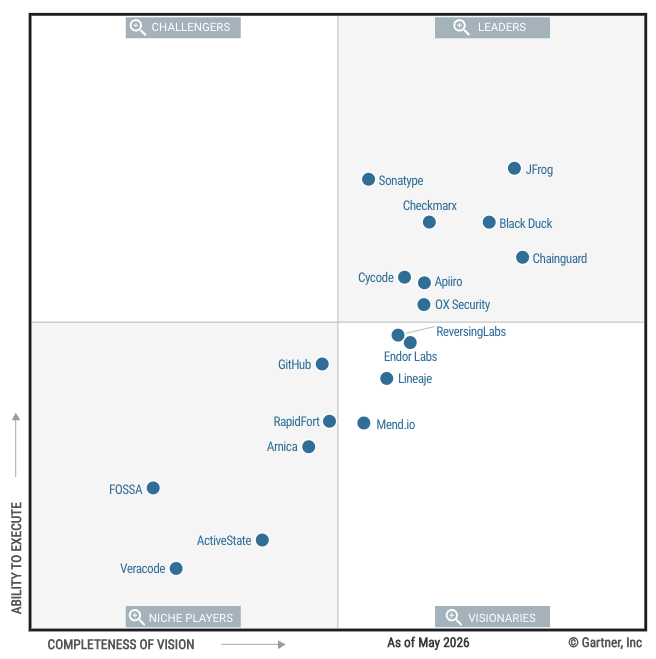

Did you know that you only control about 15% of your software? The other 85% is open-source code, and it is likely hiding below the surface with undetected risks. A recent Gartner report on Container Supply Chain Security highlights that vulnerabilities hidden throughout the software supply chain are putting containerized deployments and infrastructure at major risk.
With AI exponentially compounding these security threats through massive code volume and faster exploit times, securing the code you don't write has never been more critical.
Gartner outlines 10 key supply chain vulnerabilities, pointing specifically to the dangers of vulnerable external dependencies, unsecured source code repositories, and compromised container registries. Their core guidance? DevSecOps teams must shift to using curated and hardened container images to proactively minimize their attack surface.
This is exactly where RapidFort - specifically recognized in the Gartner report as a representative vendor for Curated/Hardened Container Image Catalogs - is changing the game. RapidFort treats the entire software supply chain as a continuous security perimeter, eliminating attack vectors at the source.
Its platform operates across three stages - Intake, Build, and Runtime - removing supply chain attack vectors at each one and making continuous container security a reality rather than an aspiration. Here is how RapidFort directly solves the challenges highlighted by Gartner:
Curated Open Source Images: The Switzerland of Secure Open Source Software
Most open source vulnerabilities in containers don't originate from your code. They come from the base images and open-source foundations you build on. Gartner recommends starting builds with a "slim" or minimal container image to prevent the inclusion of vulnerable dependencies.
RapidFort addresses this directly, functioning as what the team calls the "Switzerland of Secure Open Source Software" - a neutral, trusted intake catalog of over 35,000+ curated, near-zero CVE images that serves as a secure starting point for containerized workloads, including Kubernetes environments.
Critically, you are not forced to use a vendor's proprietary open-source operating system. These hardened container images are built on the distributions your teams already trust:
Built on widely trusted Linux distributions including Ubuntu, Debian, Red Hat, and Alpine with no proprietary OS lock-in
Rebuilt and patched daily with upstream security updates to stay continuously current against new CVEs
Hardened to STIG and CIS benchmarks, aligned with NIST SP 800-70 guidance for regulated environments
Pre-integrated with SBOM and RBOM for full software supply chain transparency from day one
Starting from a clean, verified, near-zero CVE foundation removes a large category of open source vulnerability risk before development even begins - eliminating the problem of securing third-party dependencies in containers at the very first step.
Automated Remediation at Scale: Up to 99.9% Vulnerability Elimination in Days
Unused software doesn't reduce your risk just because it's never called. It still carries CVEs. It still expands your container attack surface. And it still needs to be tracked, reported on, and managed.
RapidFort profiles container images using runtime profiling to identify which components are actually executed, then automatically removes everything that isn't. This approach to removing unused components from container images delivers results no static scanner can match - and requires zero application code changes.
This is runtime-informed container image hardening that acts on real execution behavior, not static assumptions about what might be exploitable.
End-to-End Continuous Protection: Zero Gaps Across the Container Lifecycle
Container security doesn't stop at build time. Gartner stresses the need for monitoring throughout the container lifecycle. RapidFort eliminates the flawed "checkpoint" security mentality by providing continuous threat elimination with zero gaps across the Intake, Build, and Runtime stages - the complete container lifecycle.
At runtime, RapidFort:
- Establishes a behavioral baseline for expected container activity in production
- Detects anomalies and code drift in real time, catching supply chain risks that emerge post-deployment
- Issues intelligent alerts when unexpected behavior occurs, with minimal system overhead
What is verified at build time is continuously validated in production. That means no silent regressions, no blind spots, and no gaps between vulnerability scans.
Security Is No Longer Just a Checkpoint. It's a Continuous System.
The software supply chain is only growing more complex. AI is accelerating both development velocity and the speed at which new supply chain exploits reach the wild. Manual CVE remediation and periodic container vulnerability scanning are no longer sustainable strategies for DevSecOps teams operating at scale.
The teams that stay ahead are the ones that abandon the checkpoint mentality and start treating software supply chain security as something that runs continuously - from the moment you pull a base image to the moment your container is live in production.
That is exactly what RapidFort does.
AI tools are making threat weaponization faster than ever, and manual remediation is no longer sustainable. Security is no longer just a checkpoint; it must be a continuous system.
Further reading
Gartner's Container Supply Chain Security report names curated, hardened images as a baseline requirement and recognizes RapidFort as a representative vendor doing it right.
Read the Gartner report →Latest posts





Eliminate Attack Vectors at the Source
Continuously eliminate up to 99.9% of CVEs without code changes


Products
Use Case
Quicklinks
Stay in touch
Subscribe for product updates and RapidFort newsletter.
Address
440 North Wolfe Road, Sunnyvale, CA 94085


© 2026 RapidFort, Inc.
RapidFort, RAPIDFORT, and RBOM® are registered trademarks of RapidFort, Inc. All other marks and names mentioned herein may be trademarks of their respective companies.